
AI Does Not Remove the Need for Leadership. It Raises the Standard for It.
As AI increases the speed and availability of intelligence, the harder question becomes whether the organization can turn that capability into better decisions, greater capacity and meaningful leverage.
By Stephanie Paillé
Founder & CEO, 360 Leadership Coaching
Imagine Marcus, the CEO of a $40 million company.
His leadership team has been steadily introducing AI across forecasting, operations and customer support. The early signs are encouraging. Analysis that once took days can happen in hours. Teams can generate better first drafts, evaluate more scenarios and surface information faster than they could even a year ago.
And yet the organization does not necessarily feel easier to lead.
More information creates more options. Faster analysis can create more decisions. And when decision rights, judgment and accountability have not evolved at the same pace, much of that new capability can still travel upward.
AI did not necessarily create the constraint.
It may simply be making the existing architecture easier to see.
That distinction matters because many organizations are currently asking some version of the same question:
How do we get more value from AI?
The deeper scaling question may be:
Has the organization changed enough to convert what AI makes possible into greater organizational capacity and leverage?
That is a different question.
And increasingly, it is a leadership question.
The productivity gains are real. The organizational gains are less automatic.
The evidence emerging in 2026 points to an important gap.
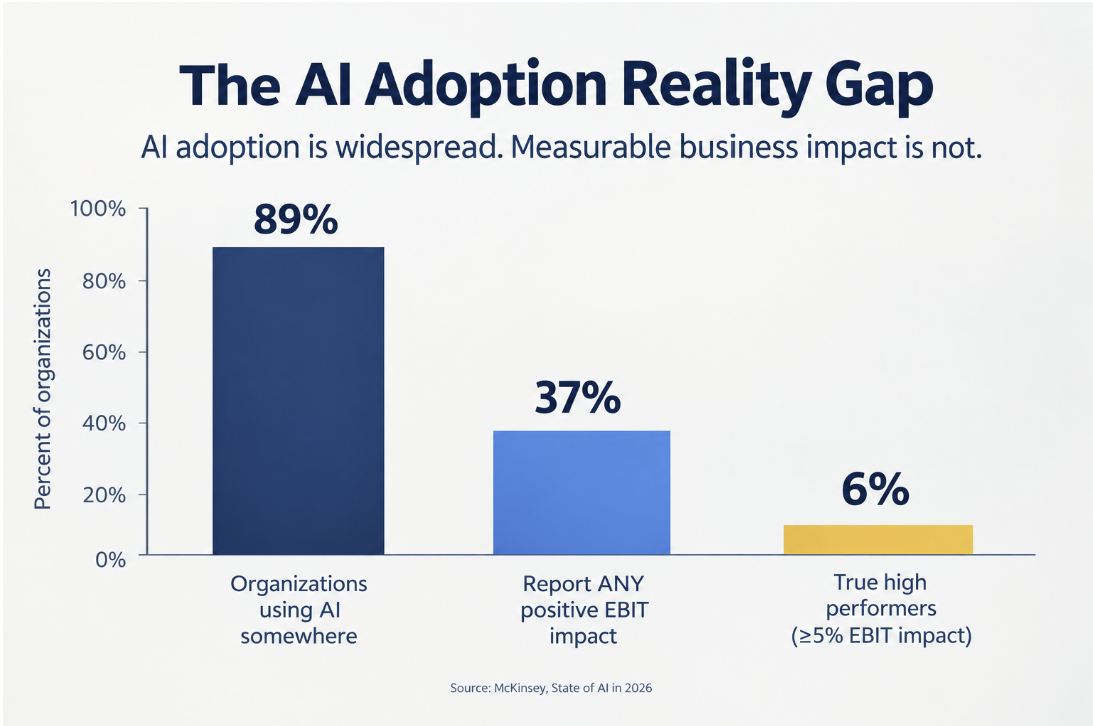
McKinsey's latest global AI survey reports that nearly nine in ten respondents say their organizations regularly use AI. Eighty percent report improvements in individual productivity.
Yet only 37% say AI has contributed to EBIT, and just 6% of respondents qualify as AI high performers organizations reporting at least 5% EBIT impact from AI alongside significant value creation.
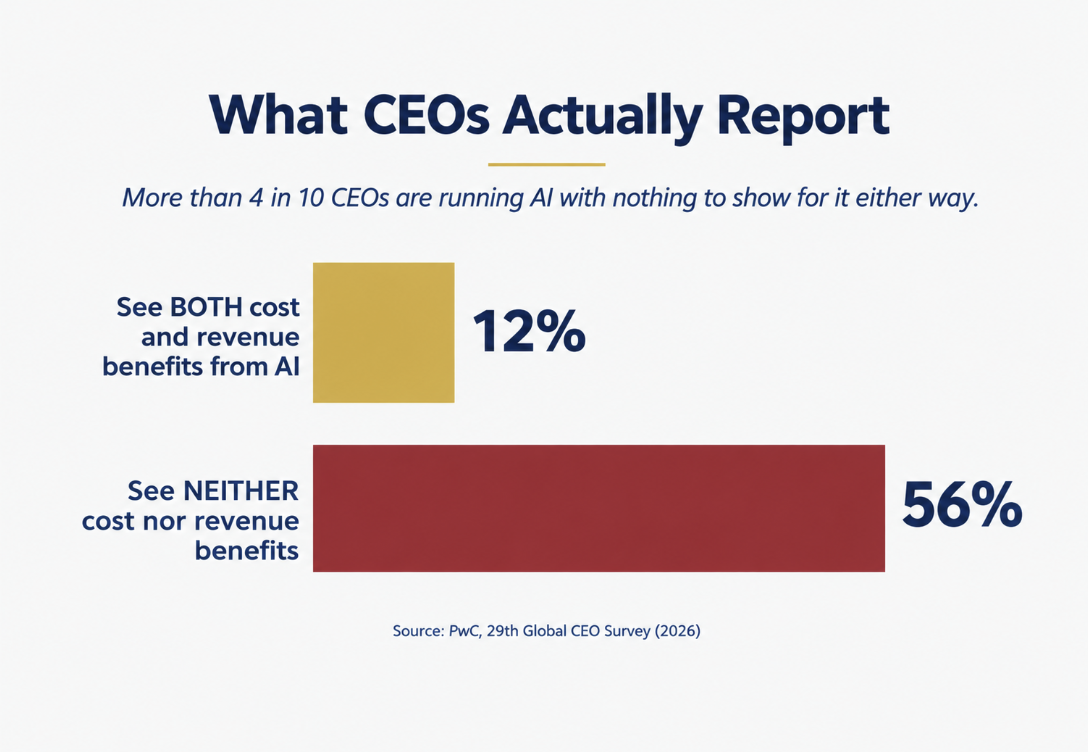
PwC's 2026 Global CEO Survey reinforces the same gap from a CEO perspective. Only 12% report that AI has generated both revenue gains and cost reductions, while 56% report neither.
BCG reaches a similar conclusion from its transformation research: technology accounts for only part of the value equation. Much of the work required to capture value sits in people, processes, and the operating model around the technology.
None of those findings prove that every company has a leadership problem. But together they point toward something important:
Technology adoption and enterprise value are not the same thing.
That is where the Scaling CEO question begins.
AI can improve a task.
It can accelerate a workflow.
It can increase the productivity of an individual.
But none of those outcomes automatically mean the organization itself has become more scalable.
Task productivity does not automatically become organizational leverage.
The question is what the organization does with the capability that AI creates.
When intelligence becomes more abundant, judgment becomes more visible
For most of business history, information was comparatively expensive.
It took time to collect.
It took people to analyze.
It took meetings to interpret.
AI is changing that equation quickly.
Organizations can generate information, analysis and recommendations at a speed that would have been difficult to imagine only a few years ago.
That creates an obvious opportunity.
It also changes where the constraint can appear.
Suppose a leadership team can now generate five sophisticated strategic options in the time it previously took to create one.
That is an analytical improvement.
But if every consequential choice still has to be escalated to one executive, the organization has accelerated the inputs without necessarily increasing its decision capacity.
More intelligence has entered the system.
The architecture through which judgment moves may not have changed.
This is one reason I believe distributed judgment will become increasingly important as AI adoption expands.
You can distribute responsibility without distributing judgment.
When that happens, the work moves.
The decisions still come back.
And AI can make that pattern visible much faster.
The companies creating more value are redesigning the system around the technology
McKinsey's 2026 research is particularly interesting here.
Nearly three-quarters of its AI high performers report fundamentally redesigning workflows because of AI use, compared with about one-quarter of other respondents. High performers are also much more likely to use AI as part of a broader business transformation rather than primarily as an efficiency tool.
Separate McKinsey research on AI-enabled operating models points in the same direction: organizations generating more value are more likely to redesign how work and decisions happen rather than simply place AI on top of existing processes.
That does not mean every organization needs a wholesale redesign.
It does suggest that there is a limit to what technology can accomplish when the surrounding system remains unchanged.
A faster tool operating inside the same decision structure, the same accountability model and the same workflow may simply accelerate the existing architecture.
Sometimes that is exactly what is needed.
Sometimes it moves the constraint somewhere else.
The leadership task is knowing the difference.
AI changes the capacity question
This is where the conversation becomes larger than productivity.
When AI removes part of the analytical or administrative load from work, the immediate question is usually:
What can we automate?
A more useful scaling question is:
What capacity are we trying to create?
Those are not identical.
Capacity may be created by hiring.
It may be created by developing people.
It may be created by delegating differently.
It may come from automation.
It may require redesigning a workflow.
It may come from simplifying something that has become unnecessarily complex.
And sometimes the right answer is to stop doing something altogether.
That is why capacity is not the same as headcount.
It is also why the value of AI should not be measured only in hours saved.
If AI returns ten hours of capacity to a team and those ten hours immediately become more meetings, more analysis and more activity, the organization may be busier without becoming meaningfully more leveraged.
Efficiency creates time. Leverage changes what the organization can produce with that time.
That is an organizational design question as much as it is a technology question.
A higher leadership standard: four requirements become more important
I do not think AI makes leadership less relevant.
I think it makes several parts of leadership harder to avoid.
Four requirements stand out.
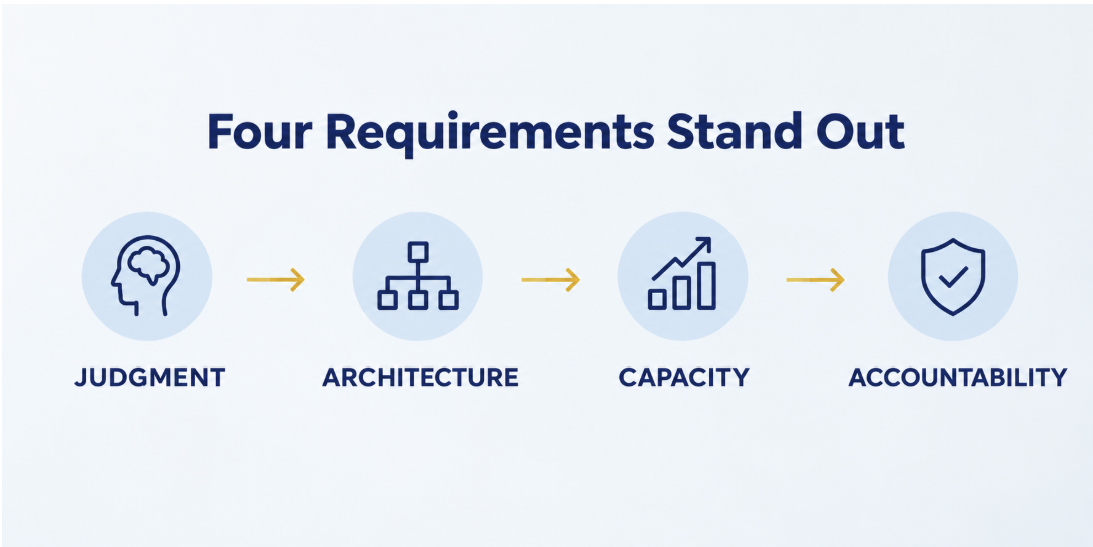
1. Judgment
What should we believe, choose or reject?
AI can surface patterns, generate possibilities and help leaders evaluate alternatives.
But important decisions still require someone to determine what matters.
What assumptions are we making?
Which trade-offs are acceptable?
What are we optimizing for?
What should remain true even when the data points somewhere easier?
What problem are we actually trying to solve?
The more abundant analysis becomes, the more important the quality of those questions becomes.
Leadership is not simply having the answer.
Increasingly, it is knowing which answer deserves to be acted upon.
2. Architecture
Where should the decision live?
AI can increase the speed at which information reaches the organization.
That makes decision architecture more important, not less.
Which decisions should remain with the CEO?
Which belong with the executive team?
Which should sit inside a function or closer to the customer?
Where is escalation genuinely necessary?
Where is it happening because decision rights were never made clear?
The goal is not to remove senior leaders from consequential decisions.
It is to ensure that judgment sits at the appropriate level, with the context and authority required to exercise it well.
That is how decision capability begins to scale beyond any one individual.
3. Capacity
What should people do, what should AI do, and what should no longer need to be done?
The easiest AI question is often:
“What can this tool take off our plate?”
The more strategic question is:
“What should the organization become capable of because this capacity now exists?”
AI can free capacity.
Leadership decides how that capacity is redeployed.
That may mean higher-value work.
Stronger customer relationships.
More strategic thinking.
Faster experimentation.
Better leadership development.
Or simply doing less of the work that no longer creates sufficient value.
The productivity gain is only the beginning.
4. Accountability
Who owns the outcome?
AI can recommend.
It can analyze.
Increasingly, it can take action.
But organizational accountability still has to be designed.
When an AI-supported decision produces a good result, who owns it?
When it produces a poor result, who is responsible for examining what happened?
Which decisions require human review?
Where must accountability remain explicit even when execution becomes increasingly automated?
As technology becomes more capable, ambiguity around accountability becomes more consequential.
The organization needs to know not only what the system can do, but where human ownership begins and ends.
Klarna illustrates why the answer is rarely “human or AI”
Klarna offers a useful public example because the story is more nuanced than the early headlines suggested.
The company's AI customer-service assistant handled a significant share of service conversations and performed work that Klarna described as equivalent to more than 700 full-time agents. The company also reported substantial efficiency gains.
Later, CEO Sebastian Siemiatkowski acknowledged that an excessive focus on cost had affected service quality, and the company moved toward ensuring customers could still access human support when appropriate. Importantly, Klarna did not abandon AI; it continued reporting meaningful value from the technology while adjusting the human side of the model.
That tension is what makes the example useful.
The lesson is not that AI failed.
Nor is it that humans must remain involved in every interaction.
The more interesting leadership question is:
Where does technology create the most value, where does human judgment create the most value, and how should the operating model bring the two together?
That question will look different in every organization.
But it cannot be answered by the technology alone
The leadership team needs a better question
Most leadership teams are already asking:
How should we use AI?
Where can we automate?
What productivity gains should we expect?
Those questions matter.
I would add several others:
Where is AI creating genuine organizational capacity rather than simply faster activity?
Which decisions still escalate unnecessarily?
Where have we distributed responsibility without distributing sufficient authority or judgment?
Which workflows should be redesigned rather than merely accelerated?
What should humans continue to own because context, judgment, trust or accountability matter?
What will we deliberately do with the capacity AI creates?
Those questions move AI from being a technology initiative into a broader conversation about how the organization scales.
And that is where Leadership Architecture becomes relevant.
AI may reveal the architecture the next stage requires
Growth changes the requirements of a company.
More customers create more decisions.
More people create more coordination.
More functions create more interdependencies.
New technology introduces new forms of capacity—and new choices about how that capacity should be organized.
The leadership system that worked at one stage may not be sufficient for the next.
That is not an indictment of the people who built it.
In many cases, the existing architecture helped create the success the company has today.
The question is whether it still fits what the company is becoming.
AI makes that question more urgent because it accelerates what organizations can know, produce and execute.
But speed by itself is not scale.
AI makes intelligence more abundant.
Leadership determines how that intelligence becomes judgment, capacity, accountability and ultimately organizational leverage.
The organizations that create the greatest value from AI may not simply be those that adopt the most technology.
They may be the ones that become better at redesigning how leadership operates around what the technology now makes possible.
AI does not remove the need for leadership.
It raises the standard for the Leadership Architecture required to scale.
Make the Conversation Count
Questions for your leadership teamBefore adding another AI tool, consider asking:
|
|---|
Explore More on Scaling Leadership
This article is part of our work on The Architecture of Scaling: how decision-making, capacity, authority, alignment and execution must evolve as organizations grow.
Themes we’ll continue exploring: Decision Architecture, Distributed Judgment, Capacity Architecture and Organizational Leverage.
Explore more insights across the Psychology, Architecture and Economics of Scaling.
Sources:
McKinsey — The State of AI: Global Survey 2026
PwC — 29th Global CEO Survey (2026)
BCG — AI transformation / 10-20-70 model
Klarna — original AI customer-service announcement (Feb 2024)
Klarna — human-support shift (Bloomberg, May 2025)