AI Is Exposing the Leadership Gaps Growth Used to Hide | Coordination Cover
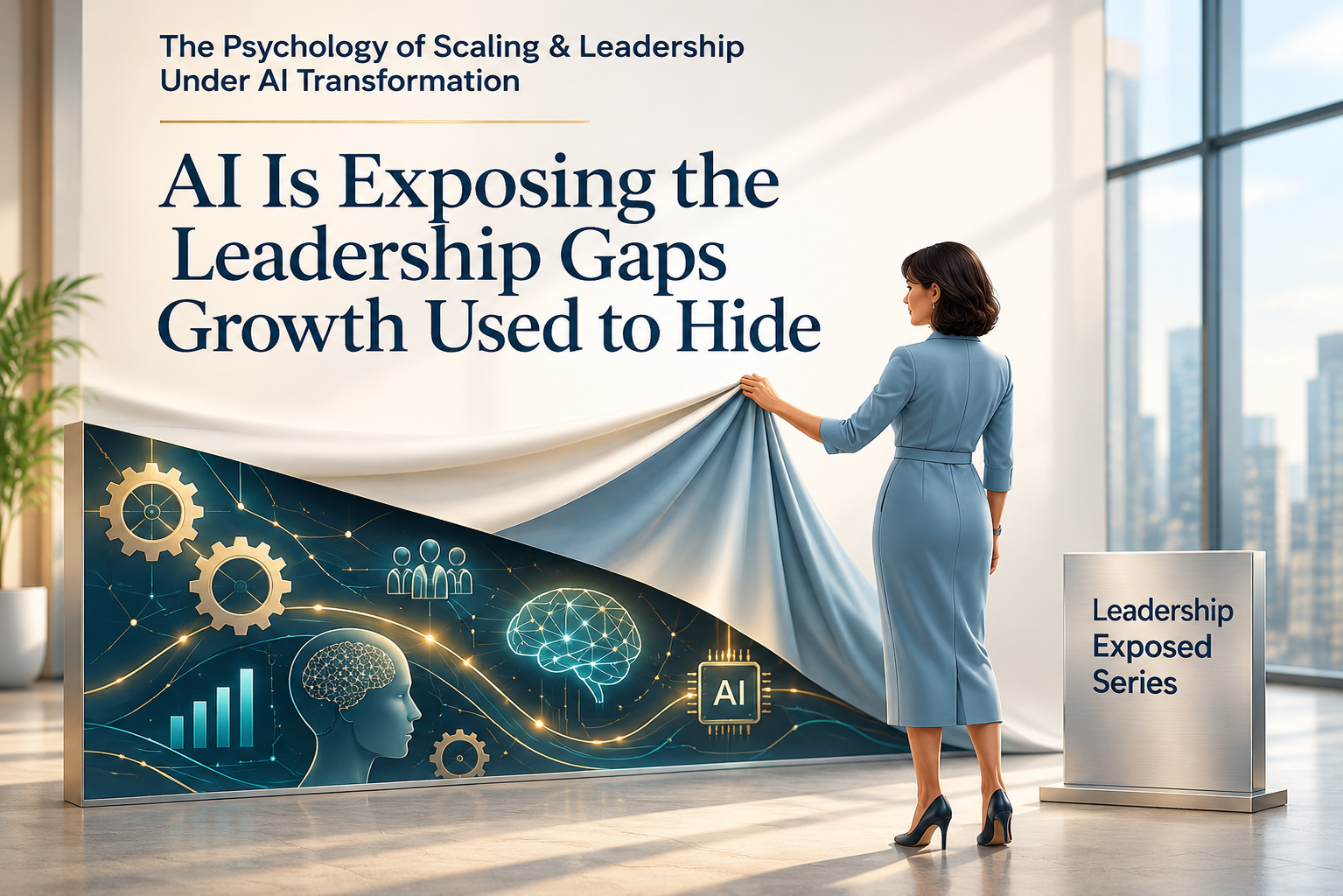
When AI absorbs the coordination work that once consumed much of a manager's role, the leadership gaps that were already there become impossible to miss.
For years, a meaningful share of a leader's time was consumed by coordination: relaying information, tracking tasks, chasing status, approving. AI is taking much of that work over. What remains shows whether a leader was leading people or managing the flow of work around them. Through the Scaling CEO lens, I call that disappearing layer Coordination Cover.
By Stephanie Paillé
Founder & CEO, 360 Leadership Coaching
Nadia is the founder and CEO of a $32 million professional services firm with about 180 people.
Six months ago, she rolled out AI tools across the company. The early results were everything she had hoped for. Client analysis that used to take her teams a week now takes a day. First drafts arrive sharper. Research that once required three people now requires one.
And yet the company does not feel faster.
Proposals still sit in her inbox for five days waiting for her sign-off. Two of her managers seem busier than ever, but when she asks what has changed in how they lead their teams, neither has a clear answer. Their calendars look almost exactly the way they did a year ago.
Then, in a skip-level conversation, a senior analyst tells her something she did not expect. Half the team uses AI tools nobody has formally discussed. They haven't mentioned it, the analyst says, because they assume that if anyone sees how much faster they are, they will simply be handed more work.
The technology worked. What it revealed is harder to look at.
Nadia is leading a company whose leadership system was built around work that AI has just taken away. For the first time, she can see what that work was covering.
The real question isn't whether AI will replace leaders
Most of the public conversation about AI and leadership is still asking some version of the same question:
Will AI replace our managers?
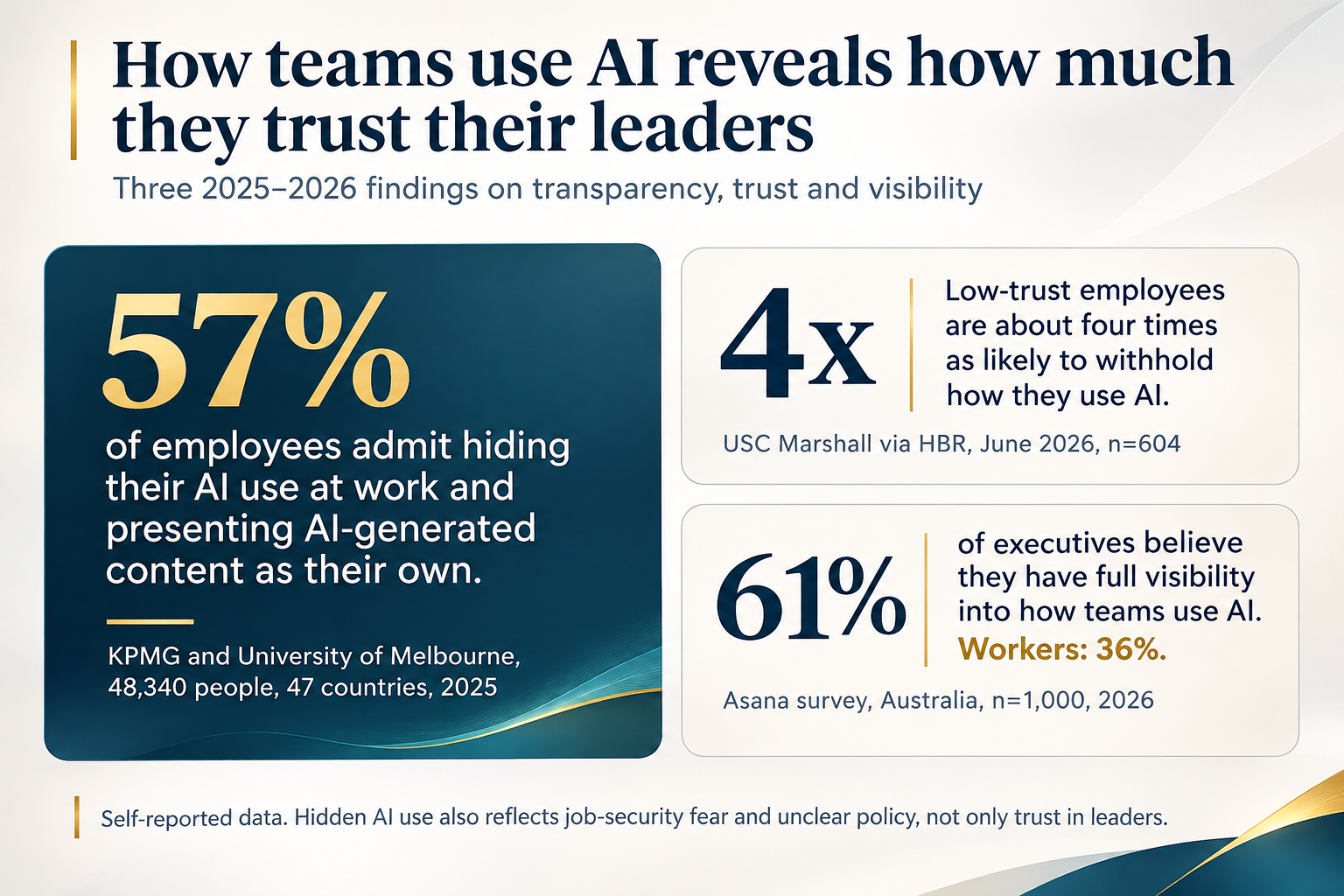
It's a fair question, and the honest answer is: partly. Gartner has predicted that through 2026, 20% of organizations will use AI to flatten their structure, eliminating more than half of their current middle-management positions. Some of what managers do is being automated. Some management layers will shrink.
But that question misses what most CEOs are actually living through.
AI is not removing the need for leadership. It is removing the work that used to make gaps in leadership hard to see.
The real question isn't "will AI replace our leaders?" It's "what will AI reveal about how we lead, once the coordination work is gone?"
The evidence: AI is absorbing work that once consumed much of a manager's role
The research emerging in 2025 and 2026 points in two directions at once.
First, AI is absorbing coordination work. Microsoft's 2025 Work Trend Index, drawn from roughly 31,000 workers across 31 countries, found that leaders expect their teams to be training AI agents (41%) and managing them (36%) within five years. Microsoft's own description is that every employee becomes an "agent boss." Oversight that used to belong to a manager is being spread across the team.
A 2025 field experiment with 776 professionals at Procter & Gamble went further. Individuals working with AI performed about as well as two-person teams working without it, and did so in less time. One of the oldest reasons for teams, and for the managers who coordinate them, is to combine expertise. AI is starting to supply part of that on its own.
Gartner's 2026 work on what it calls the AI-shaped organization describes the consequence for managers: those who function mainly as "middleware" between information and people become less effective, while time shifts toward coaching, trade-offs, and accountability.
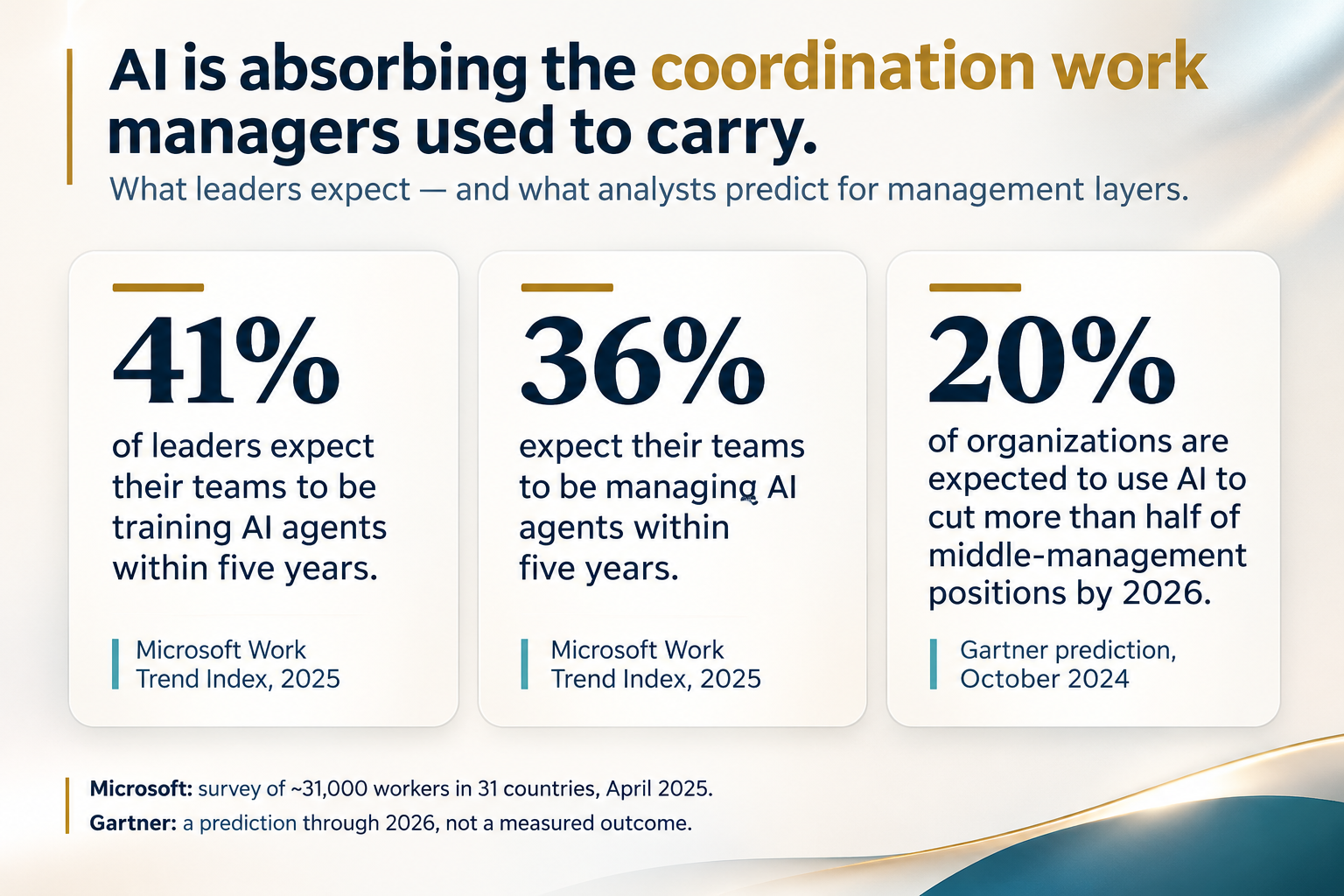
Second, AI is revealing how much people trust their leaders with the truth. The 2025 global study by KPMG and the University of Melbourne, covering 48,340 people in 47 countries, found that 57% of employees admit to hiding their use of AI at work and presenting AI-generated content as their own. Only 40% said their workplace had a policy or guidance on generative AI use.
Research from USC Marshall, reported in Harvard Business Review in June 2026, studied 604 U.S. employees who use AI daily. Organizational trust was the strongest predictor of whether they shared their AI techniques. Low-trust employees were roughly four times more likely to keep them to themselves.
The gap shows up from the top, too. A 2026 Asana survey of 1,000 Australian leaders and workers found a significant perception gap. Executives rated their organization’s AI execution 75 out of 100, while workers gave it just 58 out of 100. And while 61% of executives believed they had full visibility into how their teams use AI, only 36% of workers agreed.
None of these findings prove that every hidden prompt is a verdict on the leader. Some of it is job-security fear. Some are policy confusion. But together they point to something worth sitting with:
AI is taking coordination work off leaders' plates at the same moment it is showing how much their people trust them.
When the coordination disappears, the leadership underneath becomes visible
For most of business history, a leader's day was full of work that looked like leadership.
Relaying information. Chasing status. Tracking who was doing what. Summarizing. Approving. Being the person who knew.
That work was real. It kept companies running. It was also cover.
I call it Coordination Cover: the layer of information relay, status tracking, and task-chasing that made a leader look indispensable, whether or not they were exercising judgment, building trust, or developing people.
AI is dissolving that layer quickly. When the status report writes itself, the summary arrives before the meeting, and the analysis is ready in an hour, what is left on a leader's plate is the work AI can't do.
Deciding what matters. Giving people context. Building enough trust that people tell you what's really happening. Developing the people who will make the next hundred decisions.
Some leaders find that liberating. Others discover it was never most of their job.
That isn't a character flaw. It's what the role rewarded at an earlier stage of the company. When a business is small, being the hub is leadership. As it grows, the hub becomes the constraint, and AI makes that visible in months instead of years.
This is a documented pattern, not a personal failure
Neither half of this is new. What's new is the speed.
Eliyahu Goldratt's Theory of Constraints, introduced in The Goal in 1984, rests on a simple observation: a system can only move as fast as its slowest step. Speeding up any other step doesn't increase output. It builds a longer queue in front of the constraint.
That is exactly what happens in Nadia's company. When AI turns a week of analysis into a day, the proposal doesn't reach the client four days sooner. It waits four days longer in her inbox. The constraint was always there. AI made it the longest step in the process.
Amy Edmondson's research on psychological safety, first published in 1999, explains the other half. People withhold questions, mistakes, and new ways of working when speaking up feels interpersonally risky. A team quietly using AI tools it hasn’t talked about is often doing exactly what that research would predict.
One idea explains why work stalls at the leader. The other explains why people stop telling the leader the truth. AI tests both at once.
Why "more AI training" and "an AI mandate" don't fix it
The instinct, understandably, is to add. Add AI training. Add a Chief AI Officer. Add a mandate, or make AI use part of performance reviews.
None of those are wrong. They are aimed at the wrong layer.
Training teaches people the tool. It doesn't change whether they trust their leader enough to show how they use it. A mandate issued without context can make the problem worse: usage climbs on the dashboard while honesty about how work actually gets done goes down. A Chief AI Officer can own the technology, but not the founder's approval queue or the trust climate on a leadership team.
And "leaders need to become more tech-savvy" misses the point entirely. The gap AI exposes is rarely tool fluency. It is judgment, communication under uncertainty, and the ability to lead people rather than track their work.
AI fluency changes what a leader can do with the tool. It doesn't change what the tool reveals about how they lead.
Four ways winning hides Success Load
Four ways winning hides Success Load
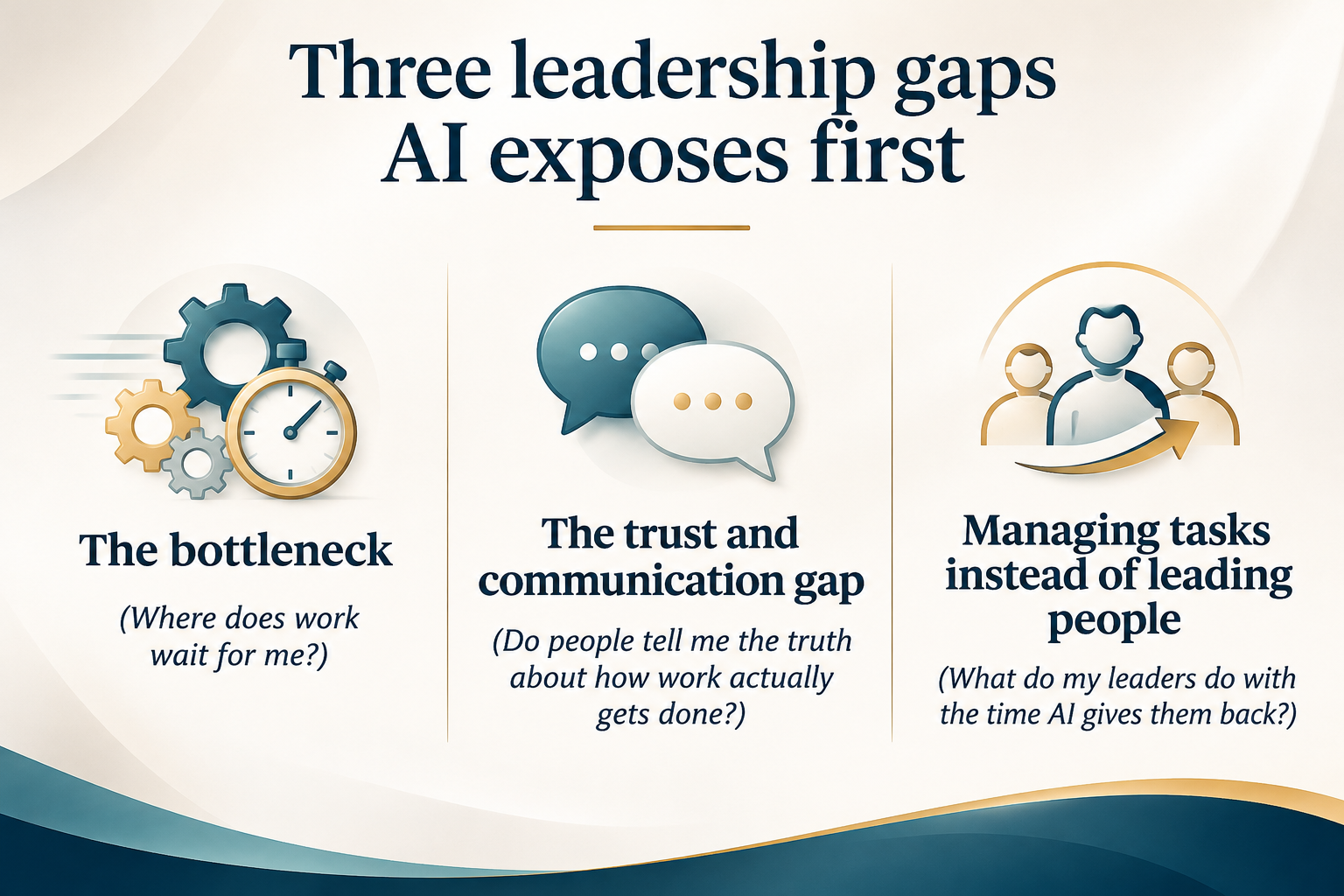
1. The Bottleneck
Where does work wait for me?
What happens: team output accelerates, and the CEO's approval cycle doesn't. The founder becomes the longest single step in a process that is faster everywhere else.
Early signs: a growing "waiting on you" queue. Teams starting work before approval to avoid the delay. Turnaround times that improved everywhere except where you sign.
Release: "Quality depends on me seeing it before it goes out."
Build: "Quality depends on standards and decision ownership clear enough that most work doesn't need me."
2. The trust and communication gap
Do people tell me the truth about how work actually gets done?
What happens: people hide their AI use, keep their techniques to themselves, and quietly absorb the time they save rather than reveal it. Often the reason is simple. They expect that visible productivity will be met with higher targets or fewer roles. AI rolled out by directive, without explaining what it means for people's jobs, deepens the silence.
Early signs: almost no voluntary sharing of workflows or prompts. Shifts in quality nobody can explain. Polite, vague answers when you ask how teams are using AI.
Release: "If I announce it clearly, people will follow."
Build: "People share how they work when they know what happens to them if they do."
3. Managing tasks instead of leading people
What do my leaders do with the time AI gives them back?
What happens: managers whose role was mostly coordination cover the freed hours with more coordination: checking AI output, aggregating status, adding meetings. They look busier than ever. Managers who lead people redeploy the time toward judgment, development conversations, and the problems worth solving.
Early signs: managers' calendars unchanged months after AI tools went live. Coaching that is always planned and rarely happens. Saved time that turns into more tasks rather than better work.
Release: "My job is to make sure the work gets done."
Build: "My job is to build people who can decide which work is worth doing."
None of the three is new. Each one used to take years to surface: a missed quarter, a regretted resignation, a stalled initiative. AI surfaces them in months.
Procter & Gamble: what this looks like inside a real company
In 2024, researchers from Harvard Business School and colleagues ran a field experiment with 776 Procter & Gamble professionals working on real product-innovation challenges. Some worked alone and some in two-person cross-functional teams, with and without AI.
The results were striking. Individuals working with AI performed at roughly the level of teams working without it, and spent less time doing so. Teams working with AI produced the strongest results of all, and their ideas were about three times as likely to rank in the top 10% for quality as those from individuals working without AI.
That combination is what makes the example useful.
The lesson is not that teams, or the people who lead them, are becoming obsolete. The best outcomes came from people and AI working together. The lesson is that AI can now provide part of what coordination used to deliver: pulling expertise together and moving information across functions.
What it can't supply is the decision about which problem is worth solving, who should own it, and whether a team trusts each other enough to use what it finds. That is the leadership that's left when the coordination is handled.
The study has limits worth naming. It was one company, focused on innovation tasks, over a short period, and it wasn't designed as a study of leadership. It shows the mechanism, not the outcome for every organization. But it is a clear look at what happens to the value of coordination once AI enters the room.
Here's the shift
Most leadership teams are already asking:
How do we get our people ready for AI? Which tools should we roll out? What productivity gains should we expect?
Those questions matter. The more useful question is about the leaders themselves:
The question isn't "how do we get our leaders ready for AI?" It's "what will our leaders have left to do once AI handles the coordination, and are they ready to do it?"
This is where the warning and the opportunity turn out to be the same thing.
Most leadership gaps take years to become visible. AI is giving every CEO a fast, honest stress test of how their company is actually led: where work waits, whether people tell the truth, and whether managers lead people or track tasks. Uncomfortable as it is, few diagnostics are that clear.
That's what Coordination Cover is. Not a reason to fear AI, and not a reason to blame the leaders who relied on it. It is the layer that made leadership look complete, now being removed, so you can see what needs to be built underneath it.
AI will replace some of what managers do. It will not replace leadership. It will show you, faster than anything before it, where that leadership was there and where it wasn't.
AI doesn't replace leaders. It exposes them. For the CEO willing to look, that exposure is where the redesign begins.
Questions for your leadership teamBefore your next AI rollout or leadership offsite, ask:
|
|---|
Explore More on Scaling Leadership
This article is part of our work on the Psychology of Scaling: how a CEO's judgment, identity, and leadership must evolve as the company grows, and as the tools it runs on change.
Themes we'll continue exploring: Coordination Cover, Decision Architecture, trust as a leadership system, and what leaders do with the capacity AI returns.
Sources:
Microsoft, "2025: The Year the Frontier Firm Is Born," Work Trend Index, April 2025
Microsoft, "The 2025 Annual Work Trend Index: The Frontier Firm Is Born," April 23, 2025
Gartner, "Gartner Unveils Top Predictions for IT Organizations and Users in 2025 and Beyond," October 22, 2024
Gartner, "The AI-Shaped Organization," 2026
Fabrizio Dell'Acqua et al., "The Cybernetic Teammate: A Field Experiment on Generative AI Reshaping Teamwork and Expertise," Harvard Business School Working Paper, 2025
KPMG & University of Melbourne, "Trust, Attitudes and Use of Artificial Intelligence: A Global Study 2025"
Harvard Business Review, "Why Employees Aren't Transparent About Their AI Usage," June 2026
Asana Australia survey, reported by HR Tech Edge, October 2026
Eliyahu M. Goldratt & Jeff Cox, The Goal: A Process of Ongoing Improvement, North River Press, 1984. Summary via the TOC Institute
Amy Edmondson, "Psychological Safety and Learning Behavior in Work Teams," Administrative Science Quarterly, 1999