Don't Build an AI Strategy. Build an AI-Ready Organization.
Most scaling companies don't need a better AI plan. They need an organization that can absorb one.
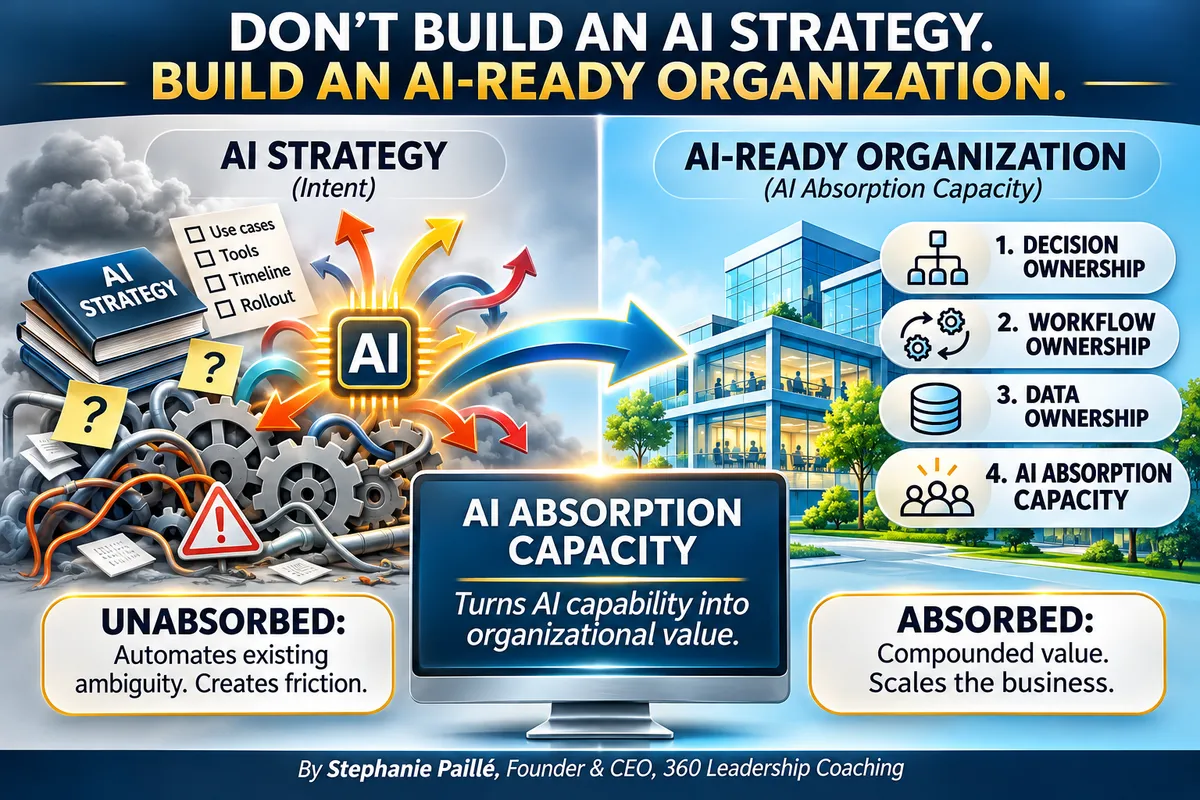
An AI strategy describes what a company intends to do with AI. Readiness determines whether the organization can actually do it. For most scaling companies, the gap between the two isn't technical. It's architectural: who owns the decisions, the workflows, and the data, and whether the leadership team has the capacity to absorb the change. In the Scaling CEO lens, I think of that organizational capability as AI Absorption Capacity.
By Stephanie Paillé
Founder & CEO, 360 Leadership Coaching
Imagine Grace, the CEO of a $42 million industrial distribution company.
At her last board meeting, one of her directors asked the question she now hears everywhere: “What's our AI strategy?” Her peer group is asking it. Two vendors pitched her a 90-day AI roadmap in the same month. A competitor just announced an AI-powered ordering portal.
So Grace does what a responsible CEO does. She commissions a strategy. A consultant interviews her leadership team, maps twenty-two use cases, scores them and delivers a polished deck with a three-phase rollout.
The deck is good. The problem is what it lands on.
Order entry still runs on the knowledge of three long-tenured people who know which customers need special handling and why. Pricing exceptions still route to Grace, because no one else has ever been told where their authority ends. Customer data lives in four systems that disagree with each other, and nobody owns the question of which one is right. And a good share of her team is already using AI to draft quotes and emails on personal accounts, with no guidelines, because no one decided whether they should.
None of that appears in the strategy. All of it determines whether the strategy works.
Grace doesn't have an AI problem. She has an organization that was never designed to absorb one.
The strategy that reassures the board is not the organization that delivers it
This is where many CEOs misdiagnose what's happening. They feel pressure to have an answer about AI, so they produce one: a strategy, a roadmap, a list of pilots. It feels like progress. It is often the first thing a board can see.
But a strategy describes intent. It doesn't create the conditions to act on it. For most scaling companies, the binding constraint isn't a shortage of AI ideas. It's whether the organization's decision rights, workflows, data and leadership capacity can carry what any of those ideas would ask of it.
The real question isn't “What should our AI strategy be?”
It's “Is our organization built to absorb what an AI strategy would ask of it?”
The evidence:
The middle market has adopted AI. It hasn't absorbed it.
RSM's 2026 Middle Market AI Survey, drawn from 1,030 executives at U.S. and Canadian middle market organizations already using AI, found that 86% say AI is integrated into their operations. Only 36% have it fully embedded across core processes. Ninety-seven percent report satisfaction with AI's business value, though RSM notes that many organizations are measuring early wins rather than enterprise-wide outcomes.
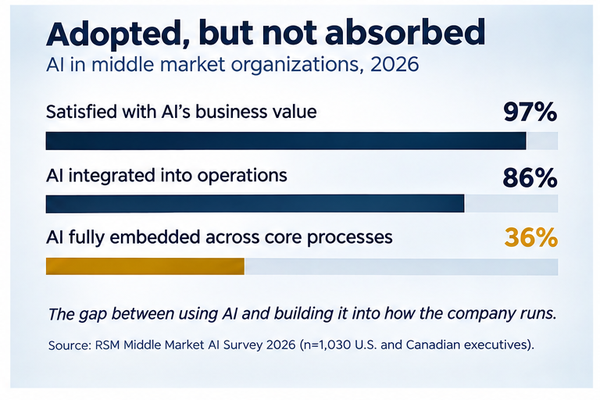
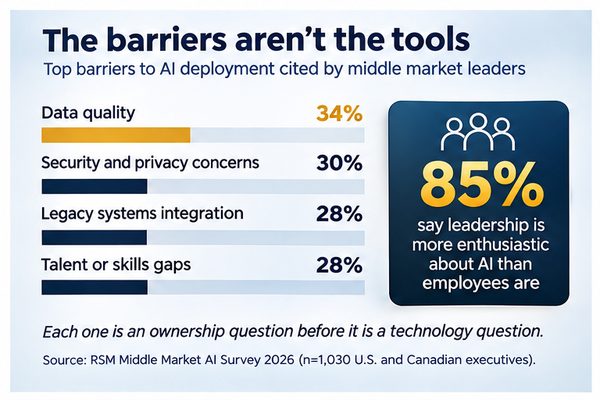
RSM's own reading of that gap is worth noticing. It describes the barriers not as technology shortfalls but as symptoms of organizations that have not yet evolved how work gets done, how decisions are made, and how AI is embedded into core processes. The same survey found that 85% of respondents say leadership is more enthusiastic about AI than employees are.
U.S. Census Bureau data shows the same shape from a different angle. Its spring 2026 AI supplement to the Business Trends and Outlook Survey found that most AI-using firms (57%) use it in only one to three business functions. Adoption is spreading. Depth is not.
And AI isn't waiting for the strategy. Pax8's Q3 2026 SMB AI Pulse, a survey of 1,150 leaders at companies with 5 to 499 employees across the U.S., U.K., Germany and Sweden, found that 35% of AI-engaged businesses discovered AI tools, workflows or agents operating without official approval in the previous six months alone.
None of this proves every mid-market company is unready. But it points to something worth sitting with: access to AI is no longer the scarce resource. The organization's ability to operate differently is. In many companies, AI has already arrived through employees, long before the leadership team has decided who owns it.
This is a documented pattern, not a technology failure
What Grace is experiencing is not new. It is one of the most consistent findings in the history of technology adoption.
Economic historian Paul David's study of factory electrification found that the productivity gains from electric power took decades to appear. Early adopters replaced the steam engine with an electric motor but kept factories organized around the same central drive shaft. The real gains arrived only when factories were redesigned around what electricity made possible: new layouts, motors at individual machines, work reorganized around the flow of production. The technology was ready long before the organizations were.
Research on the computer era found the same thing. Erik Brynjolfsson and Lorin Hitt showed that the returns to information technology were closely tied to complementary organizational changes, including more decentralized decision-making, new work practices and investment in skills, and that those organizational investments could be considerably larger than the spend on the technology itself. Later work by Brynjolfsson, Rock and Syverson described a “productivity J-curve”: general-purpose technologies require significant intangible investment in processes, skills and business models before their value becomes visible.
Current Canadian evidence points the same way. A 2026 Statistics Canada study by Li and Liu found that firms with stronger complementary capabilities, such as data analytics, cloud computing, R&D and technology training for employees, were significantly more likely to adopt AI.
AI is increasingly understood as a general-purpose technology. And it appears to follow an old rule: technology creates more value when the organization evolves around what it makes possible.
Why “write the AI strategy” doesn't fix it
The instinct, understandably, is to act on the technology: write the strategy, choose the tools, appoint someone to lead AI, run a pilot. Each step is reasonable. None of them reaches the layer where the constraint actually lives.
A strategy can name twenty use cases without naming who owns the decision each one is meant to inform. A tool can be deployed into a workflow no one owns end to end, at which point it automates the ambiguity along with the work. An AI lead can be appointed without authority over the budgets, workflows or data definitions they would need to change.
A strategy problem is frequently a readiness problem wearing a strategy problem's clothes.
This is not an argument for waiting. The same J-curve research suggests organizations build their intangible capabilities partly through use; experimentation is how they learn. The distinction that matters is ownership. Narrow, owned experiments build readiness. Broad, unowned rollouts expose the lack of it.
Four conditions that make an organization AI-readyt
Readiness is not a technology maturity score. It is a set of leadership architecture conditions, and most of them can be built before you buy a single new tool.
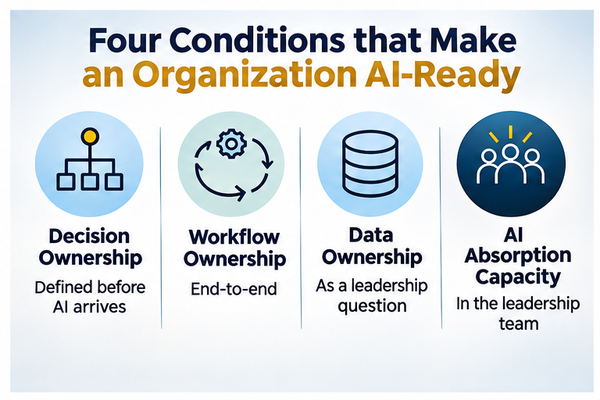
1. Decision ownership, defined before AI arrives
Before AI informs a decision, someone must own it. Which calls will AI inform first? Who makes them today? Where does their authority end? Release: “We'll sort out who decides once the tool is live.” Build: “We know who owns this decision now, and the tool will inform them.”
What happens without it: AI recommendations travel upward to the same few people who were already the bottleneck.
2. Workflow ownership, end to end
AI gets inserted into workflows. If no one owns a workflow from start to finish, if it lives in tribal knowledge and informal handoffs, AI accelerates the individual steps and leaves the seams untouched. Release: “The people who've always done it know how it works.” Build: “Every core workflow has a named owner and enough clarity to be redesigned, not just sped up.”
What happens without it: local efficiency, enterprise friction. The tool automates the mess.
3. Data ownership as a leadership question
Data quality was the most commonly cited barrier to AI deployment in RSM's survey, at 34%. It is usually treated as an IT problem. More often, it is an ownership problem: no one in the business has been made accountable for which system is the source of truth for customers, pricing, or product. Release: “Data is IT's problem.” Build: “Every critical data domain has a business owner accountable for its quality.”
What happens without it: pilots stall on “the data isn't ready,” indefinitely.
4. AI Absorption capacity in the leadership team
Redesigning decisions, workflows, and data ownership takes leadership time and attention, usually from the same team already running the business. It also requires a decision about what happens to the capacity AI releases. Release: “We'll find the time.” Build: “We've protected leadership capacity for this work and decided what freed-up capacity is for.”
What happens without it: the strategy lives in a deck, employees work around it, and saved hours quietly disappear into more activity.
ISTS: what this looks like inside a real company
International Scholarship and Tuition Services (ISTS), a Nashville-based firm that manages scholarship and tuition-assistance programs for corporations and foundations, offers a useful example. Not because it skipped strategy, but because of what its strategy was made of.
According to Vistage's account, CEO Becky Sharpe did not start with tool selection. She started by sharing a four-year vision with her leadership team on how AI could strengthen the company and the client experience. That vision shaped an AI roadmap tied directly to the company's strategic plan, rather than a standalone technology plan running beside it. Now in its third year, ISTS is focused on AI governance and on building company tools, training and reporting around individual roles, so that use is consistent across the organization rather than left to individual initiative. Scaling those capabilities is the work of year four.
The company reports 3,992 hours of labor savings, five-figure expense reductions and a 25% increase in overall productivity. One investment alone, Gemini-enabled document processing, has helped ISTS avoid backfilling two full-time positions left vacant through attrition.
Those results are self-reported, and the public account doesn't detail how decision rights changed internally. But the sequence is instructive: leadership alignment first, AI anchored to the strategic plan, governance and role-level ownership built before scale, and a clear choice about what the released capacity would be used for. In practice, the “strategy” was a readiness plan.
The lesson isn't that a company should never have an AI plan. It's that the plan has to be about the organization, not only about the technology.
Here's the shift
The question isn't “What's our AI strategy?”
It's “What would have to be true about how we decide, own and operate for any AI strategy to work here?”
You don't get value from AI by writing a better plan for it. You get value from AI by building an organization that can absorb what it makes possible.
That's AI Absorption Capacity: the decision ownership, workflow ownership, data ownership and leadership capacity that determine whether an organization can turn AI into results. The idea builds on a much older concept in organizational research. Wesley Cohen and Daniel Levinthal's research on absorptive capacity found that an organization's ability to recognize, absorb and apply new knowledge depends on what it has already built, which means it accumulates over time. Companies that start the readiness work now are not delaying AI. They are compounding the capability that will make every future AI decision pay off.
It isn't a technology decision. It's a design decision.
Questions for your leadership teamBefore commissioning an AI strategy, ask:
|
|---|
Explore More on Scaling Leadership
This article is part of our work on the Architecture of Scaling: how decision rights, authority, accountability and leadership systems must evolve as new technologies increase organizational complexity and decision speed.
Explore more insights across the Psychology, Architecture and Economics of Scaling.
Sources:
RSM US, “RSM Middle Market AI Survey 2026: U.S. and Canada,” July 2026
RSM US, survey report (PDF), 2026
U.S. Census Bureau, “Large Firms With at Least 20 Employees Biggest AI Users,” Business Trends and Outlook Survey, May 2026
U.S. Census Bureau, BTOS AI Supplement, Spring 2026 public data release
Pax8, “Q3 2026 Pax8 SMB AI Pulse Report,” October 12, 2026
Jiang Li & Huju Liu, “Artificial intelligence adoption and productivity in Canadian firms,” Statistics Canada, Economic and Social Reports, April 2026
Paul A. David, “The Dynamo and the Computer: An Historical Perspective on the Modern Productivity Paradox,” American Economic Review, 80(2), May 1990, pp. 355–361
Erik Brynjolfsson & Lorin M. Hitt, “Beyond Computation: Information Technology, Organizational Transformation and Business Performance,” Journal of Economic Perspectives, 14(4), 2000
Erik Brynjolfsson, Daniel Rock & Chad Syverson, “The Productivity J-Curve: How Intangibles Complement General Purpose Technologies,” American Economic Journal: Macroeconomics, 13(1), 2021
Wesley M. Cohen & Daniel A. Levinthal, “Absorptive Capacity: A New Perspective on Learning and Innovation,” Administrative Science Quarterly, 35(1), 1990, pp. 128–152
Vistage, “CEO Pulse: Early AI Adopters See Big Returns,” 2026