Leadership Does Not Require Everyone's Approval: How CEOs Make Hard Decisions
Psychology of Scaling
Originally published September 2023 · Updated October 2026
As a company scales, the instinct to keep everyone on board is what built the trust the CEO relies on. It is not the instinct that lets them make the calls that scale actually requires.
By Stephanie Paillé
Founder & CEO, 360 Leadership Coaching
Meet Renata, the CEO of a $45 million company.
She built the business on relationships. Clients stayed because she personally made sure they were taken care of. Her earliest hires are still there, in part because she never let a decision blindside them. When something was going to be hard on someone, she talked to them first.
That instinct built the company. It is also, right now, costing her a decision she has been sitting on for fourteen months: a legacy service line that three long-tenured team members built, and two founding clients still love, and that has been quietly losing money for two years.
She knows what the numbers say. She has known for a year. She has not made the call, because she can already picture the reactions: the team members who will feel dismissed, the clients who will feel abandoned, the board member who will ask why it took so long once she finally does it.
So the decision waits. Not because Renata lacks judgment. Because she is still leading the way the company needed her to lead when it was smaller, when every relationship in the building was personal, and keeping everyone informed and on board was the leadership system.
The leadership instinct that built the company is not automatically the instinct that scales it
This is where many CEOs misdiagnose what's happening to them. They assume a stalled decision means they need more information, more input, more time to bring people along. So they gather more input. They hold another round of conversations. They wait for something closer to consensus.
And the decision still doesn't move.
Not because the leader is weak. Because the skill that built trust reading the room, protecting relationships, keeping people bought in is a different skill from the one a harder decision now requires, and no amount of practicing the first one builds the second.
The real question at this stage isn't "how do I bring everyone along?"
It's "what does this company need me to decide, whether or not everyone comes along?"
The evidence: Being well-liked and being decisive are not the same skill
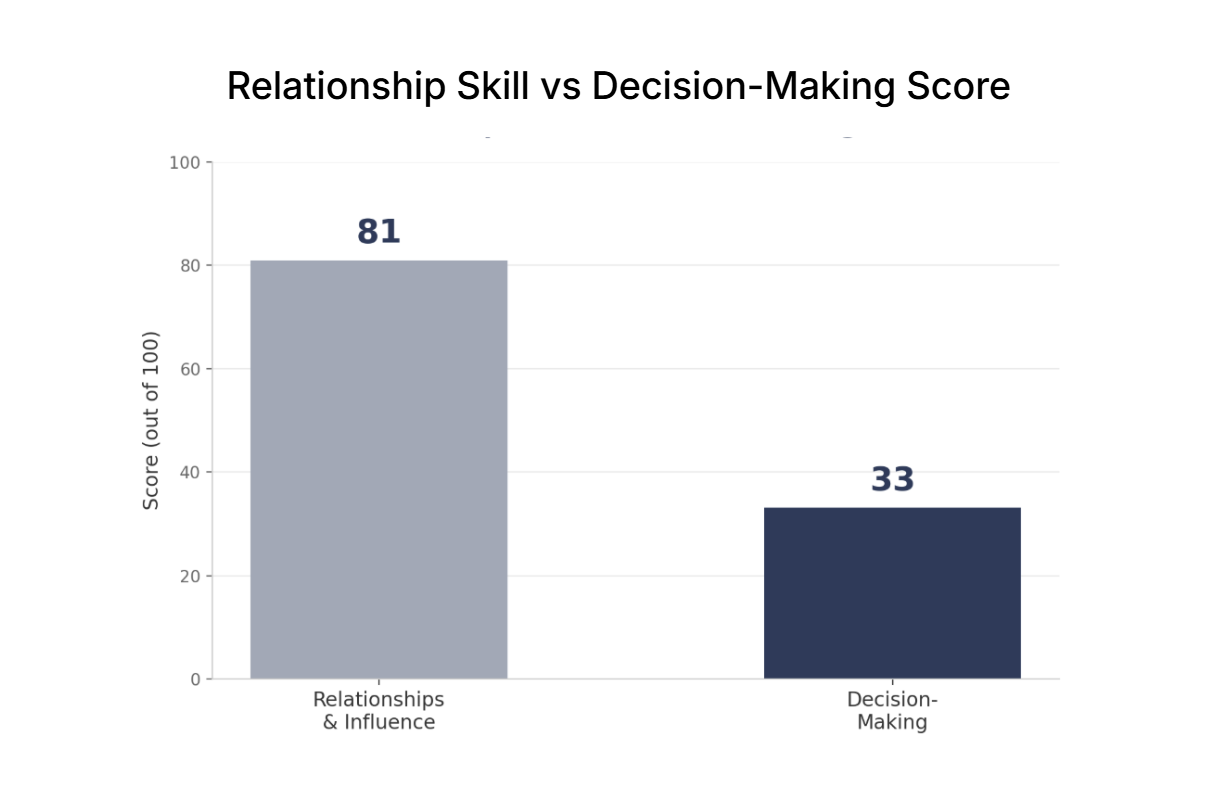
Leadership IQ's 2026 research on executive behavior, drawn from 1,207 executives assessed across five areas of leadership capability, found something specific worth sitting with: the same leaders who score highest on building relationships and political influence are, statistically, the same leaders who score lowest on decision-making.
The correlation between the two was −0.49, a strong negative relationship. Fifty-two percent of the executives studied fit a single profile: strong at building coalitions, weak at making the call when one is required.
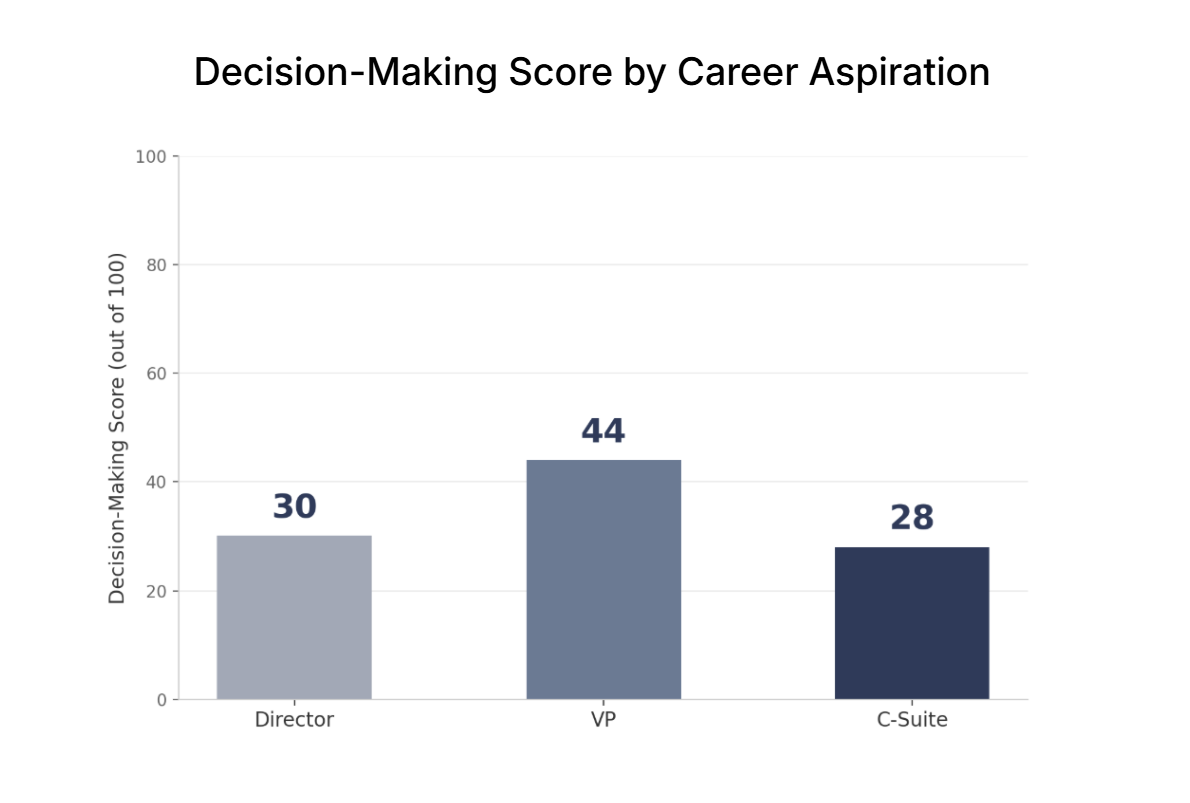
The pattern doesn't ease up as leaders get more senior. It sharpens. Leaders aspiring to C-suite roles scored the highest of any group on relationships and influence, and the lowest of any group on decision-making.
The cost of poor decision-making is not abstract. Gartner research reported by CFO.com found that weak operational decisions can materially erode profitability. In one modeled $5 billion company, the cumulative impact across decision categories such as pricing, capacity utilization, product and service improvements, vendor decisions, marketing and inventory could exceed 3% of EBITDA.
None of this proves every relationship-strong CEO has a decision problem. But it points to something worth naming plainly:
Being trusted and being decisive are two different skills, and most leaders only ever build one of them.
This is a documented pattern, not a personal failure
What Renata is feeling has a name, and it's older than her company.
Psychologist Mark Leary's sociometer theory, built on Baumeister and Leary's foundational research on the human need to belong, proposes that self-worth functions as an internal gauge of social acceptance.
People aren't imagining the stakes when they fear disapproval. Research on belonging and sociometer theory suggests that humans are highly attuned to social acceptance because, for much of human history, exclusion from the group carried real consequences. That sensitivity is useful. But in a modern company, it can also begin measuring the wrong thing.
A CEO's internal warning system does not always distinguish between “this decision threatens my standing with the group” and "this decision might make a valued employee unhappy with me on Thursday." Both can create the same instinct: caution, delay, another round of checking in.
That offers one useful lens for interpreting the Leadership IQ pattern. The leaders in that research weren't described as anxious or unstable; 74% held steady under pressure. Their decision-making didn't fail because they were rattled. It failed because slow, consensus-seeking behavior doesn't feel like avoidance from the inside. It feels like being careful. Like being collaborative. Like good leadership.
That's what makes the pattern so persistent and so hard to self-correct. The feedback a relationship-strong CEO gets from a team that loves her doesn't say "you can't decide." It says "you're a great leader to work for." The gap only becomes visible in what didn't happen: the call that should have been made a year ago.
Why "get more buy-in" doesn't fix it
The instinct, understandably, is to add: one more conversation, one more round of stakeholder input, one more attempt to find the version of the decision everyone can live with.
But if the constraint is really about tolerating disapproval, not about missing information, none of those additions reach it. A CEO can hold twenty more meetings about the underperforming service line and still not make the call, because the meetings were never actually gathering data. They were postponing the moment someone has to be disappointed.
Unanimous agreement on a consequential decision is rarely a realistic bar. Many calls worth making will please some people and unsettle others; the client roster that improves also loses the two accounts who liked things the old way; the reorg that clarifies ownership also ends a reporting relationship someone valued. Waiting for a version everyone approves of isn't diligence. It's a way of not deciding while feeling like you are.
Four requirements of a CEO who can decide without full approval
Scaling doesn't ask a CEO to care less about people. It asks them to build a different relationship with disapproval.|
1. Judgment
What is actually true here, regardless of who's comfortable with it?
Before a decision can be made, it has to be separated from how people will react to it. What does the data say? What does the company actually need? What would I decide if no one's feelings were a factor, and how much of my hesitation is really about that answer versus about delivering it?
2. Distance
Whose approval am I actually protecting, and why does it matter this much?
Not every stakeholder's reaction carries equal weight, and a CEO's sociometer doesn't sort them by importance on its own. The team member's disappointment and the board's confidence are not the same stakes. Distance means noticing when a decision is being shaped by whoever is loudest or closest, rather than by what the company needs.
3. Timing
Where does input-gathering end and deciding begin?
Consultation has a real function early in a decision. It becomes avoidance once the same ground gets covered a third and fourth time with no new information arriving. A CEO who can't name the moment consultation ends will keep finding reasons to extend it.
4. Accountability
Who owns what happens next, and am I willing to own it alone if it doesn't land well?
A decision made to keep everyone comfortable diffuses responsibility across the room. A decision made with judgment still needs someone to stand behind it, explain it, and adjust if it's wrong without treating early discomfort as proof it was the wrong call.
Each of these has to be built. None of them shows up automatically just because a leader is smart, experienced, or well-intentioned.
Egnyte: What this looks like inside a real company
Vineet Jain scaled Egnyte from four co-founders to more than 1,400 employees and over $300 million in annual recurring revenue. Along the way, he named the exact failure mode Renata is living through: as founders build leadership teams, decisions quietly drift from one person deciding to a room of people looking for the option nobody will object to. His description of it is blunt: consensus, at scale, is the shortest path to mediocrity.
Jain's fix wasn't to stop listening to people. It was structural: critical decisions at Egnyte get made by three people, not eight, with a named owner and a small team accountable for each domain; mergers and acquisitions, for instance, run through three people in business development, not a cross-functional task force.
Other leaders still get a voice. They don't get a vote on every call, and responsibility stays visibly attached to the people who own the decision, not diffused across everyone who weighed in.
The lesson isn't that broader input has no value. It's that a structure built to protect everyone's comfort will always produce the safest, least differentiated choice, and a scaling company can't out-compete on the safest choice.
Here's the shift
The question isn't "how do I become a leader everyone is comfortable with?"
It's "what does this company need someone to decide, and am I willing to be the one who's uncomfortable instead of them?"
You don't scale a company by getting better at bringing everyone along. You scale it by building the judgment to act when you can't and the accountability to own what happens next, whether or not it was popular on the way in.
That's not a personality change. It's a leadership capability, and like any other, it strengthens with use. A CEO who makes an unpopular but correct call and survives it the relationship repairs, the business improves, the sky does not fall builds real evidence against the sociometer's warning.
The next hard call gets easier not because the stakes are lower, but because the leader has proof the fear overstated the cost.
Questions for your leadership teamBefore your next leadership meeting, ask:
|
|---|
Explore More on Scaling Leadership
This article is part of our work on the Psychology of Scaling: how the internal demands of leadership evolve as companies grow, and how a CEO’s judgment, identity and decision-making must evolve with them.
Explore more insights across the Psychology, Architecture and Economics of Scaling.
Sources:
Leadership IQ, "Study: Most Executives Struggle To Make Decisions," 2026
Gartner research, reported via CFO.com, "Middle managers' poor decisions slash profits"
Mark R. Leary & Roy F. Baumeister — “The Nature and Function of Self-Esteem: Sociometer Theory,” Advances in Experimental Social Psychology, 2000
Roy F. Baumeister & Mark R. Leary — “The Need to Belong: Desire for Interpersonal Attachments as a Fundamental Human Motivation,” Psychological Bulletin, 1995
Vineet Jain / Egnyte, "Consensus Is the Shortest Path to Mediocrity: The 3-Person Decision Rule," SaaS Club