
Why Hard Decisions Get More Expensive to Avoid as Companies Scale
As companies grow, the gap between the easy decision and the right one doesn't close with experience; it widens with everything the CEO now has invested in being right.
Psychology of Scaling
Originally published September 2023 · Updated October 2026
Every scaling CEO faces the same recurring test: defend the decision they already made, or make the one the evidence now requires. That isn't a discipline problem. It's a documented pattern in how decision-makers behave once they're invested in an outcome, and it has a name: escalation of commitment.
By Stephanie Paillé
Founder & CEO, 360 Leadership Coaching
Consider Elena, the CEO of a $35 million logistics company.
Eighteen months ago, she championed a new regional expansion. She presented it to the board herself, hired the team to run it, and told her leadership group it would be the company's next growth engine.
The numbers haven't followed. Customer acquisition costs are triple the original model. Two of the four new markets are burning cash with no clear path to breakeven. Her CFO has raised it twice. Her COO has stopped bringing it up at all, not because it's fixed, but because everyone in the room already knows what happens when they do.
Elena isn't lacking information. She has the dashboard. She has the trendlines. What she's missing is the same thing most CEOs are missing at this exact moment, in a hundred different companies: a reason to make the harder call today instead of next quarter.
That gap between what the data says and what the CEO does about it is rarely a character problem.
It's an architecture problem.
Most people call it willpower. Something else is usually happening.
When a decision starts to go wrong, the instinct is to frame the next choice as a test of resolve: stay disciplined, stay strong, don't waffle. But decades of research on how people behave once they're invested in a course of action tell a more specific story, and it isn't about willpower at all.
The pattern has a name, and it isn't new
Barry Staw's original 1976 study, “Knee-Deep in the Big Muddy,” found that decision-makers who were personally responsible for a failing choice invested more resources in it after a setback, not less the opposite of what rational cost-benefit reasoning would predict.
A later study followed the pattern into the real world. Staw, Barsade, and Koput (Journal of Applied Psychology, 1997) studied 132 California banks over nine years and found that problem loans were recognized and written off more readily after senior-management turnover, consistent with the idea that responsibility for an original decision can make de-escalation harder.
The mechanism isn't laziness or a lack of resolve. It's self-justification. Reversing course means admitting the original call was wrong, in front of the same people who watched you make it. Continuing preserves the story that you were right, just early, and that story gets more expensive to give up the more publicly and completely you committed to it in the first place.
That is precisely the position most CEOs are in with their most important stalled decision. Not lacking evidence. Lacking a structure that makes reversing the call cheaper than defending it.
Speed is not the opposite of quality. Hesitation costs more than either.
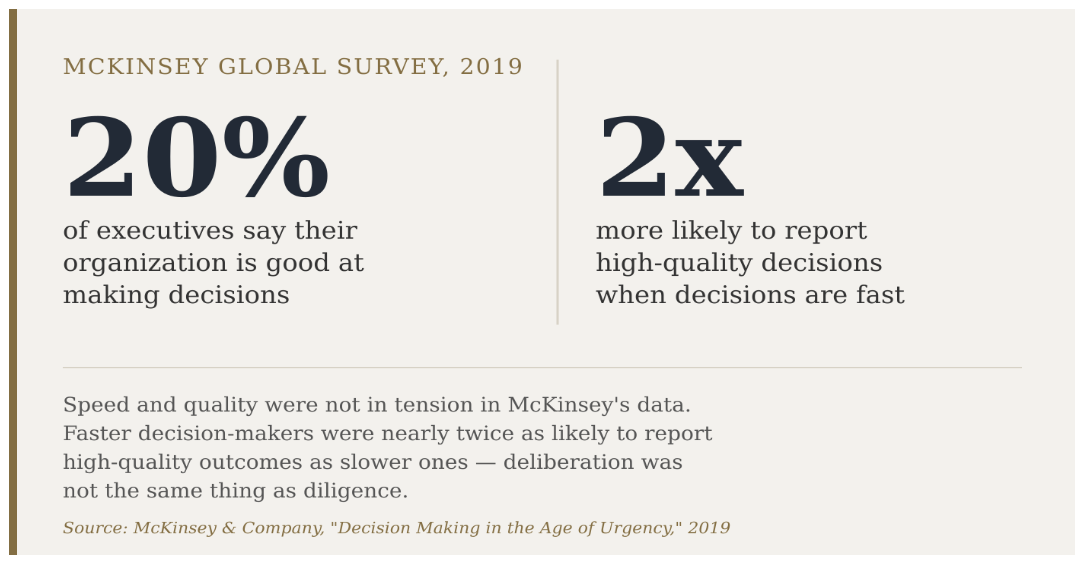
McKinsey's global survey on organizational decision-making identified only 20 percent of respondents as belonging to organizations that excelled at decision-making, and found that organizations making decisions quickly were twice as likely to report high-quality decisions as slower ones. Speed and quality were not necessarily in tension. Deliberation was not the same thing as diligence; much of the time spent making decisions wasn't improving the outcome. Sometimes, it was simply postponing the call.
That finding cuts against the instinct that hard calls deserve more time. Sometimes what looks like careful deliberation is actually the search for a version of the decision that doesn't require admitting the first one was wrong.
The question isn't “am I disciplined enough to make the hard call?” It's “does anything in how we make decisions here make the hard call more comfortable than the easy one?”
For most companies, the honest answer is no. The org chart, the reporting lines, and the CEO's own instincts are all quietly built to protect the original decision, not to pressure-test it.
Four ways the leadership architecture can make courage the default, not the exception
1. Pre-Commitment: decide the exit before you need it
The best time to set the conditions for reversing a decision is before you're emotionally invested in defending it, while the numbers are still hypothetical. Ask: at what specific point would we agree this isn't working? Write it down, with a number, before launch. Once the metric crosses that pre-agreed line, the question stops being a judgment call in the moment and becomes a commitment already made in advance.
2. Separation: remove the original champion from the continuation call
It isn't a failure of character to be biased toward your own decision; it's a predictable one. The person who championed a strategic bet may therefore be poorly positioned to evaluate its continuation alone. Build a mechanism where someone without the same identity stake reviews the call.
3. Cadence: force the review before the crisis forces it for you
Warning signs can be visible long before a leadership team acts on them. A scheduled review creates a moment where those signals have to be discussed out loud, with the people who can act on them, before the cost becomes undeniable. A quarterly kill-or-continue review, on the calendar in advance, does more work than any individual leader's resolve.
4. Cost of Reversal: make reversing cheaper than defending
When admitting a call was wrong carries a status cost for the leader while continuing quietly transfers the cost to the company, the incentives are backwards. Leadership teams that build a real habit of reversing course publicly, without ceremony, and treat it as evidence of good judgment rather than failed judgment, lower the price of doing it again next time.
Airbnb shows what this looks like when the money to keep going was still available
Airbnb in the spring of 2020 is a useful example precisely because escalation of commitment was still an option. The company had just raised $2 billion in fresh capital. Continuing to fund Airbnb Studios, its transportation ambitions, and its hotel and luxury-travel expansion wasn't impossible. It was affordable, at least for a while.
CEO Brian Chesky cut them anyway. In a memo to employees, he said the company would “reduce our investment in activities that do not directly support the core of our host community,” pausing Airbnb Studios and transportation and scaling back hotels and luxury travel, alongside a 25 percent reduction in headcount.
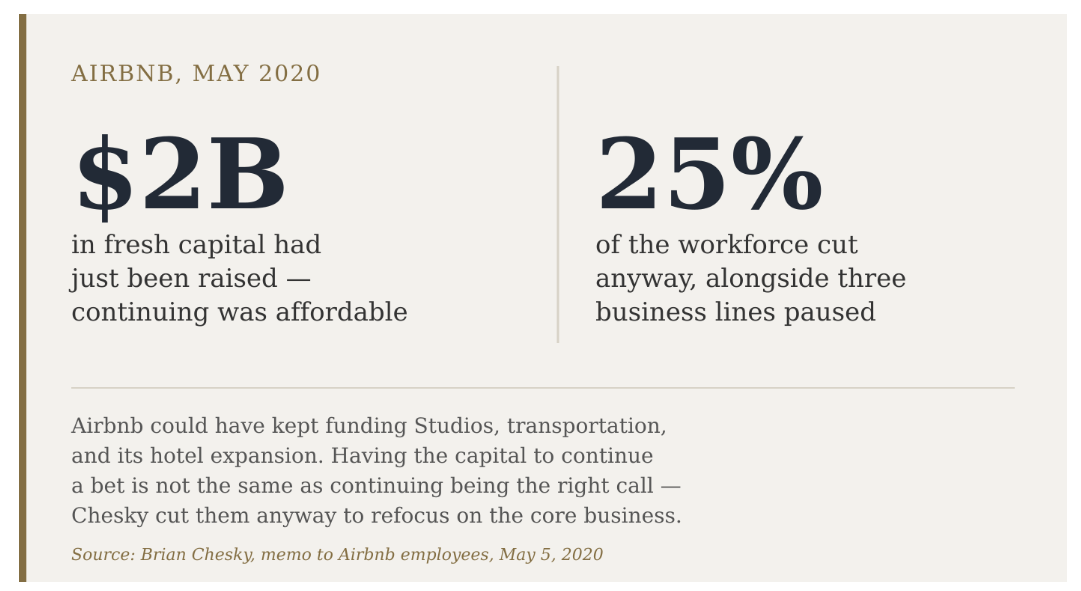
None of those businesses had necessarily failed on their own terms. What had changed was the environment they were built for. The temptation, with $2 billion in the bank, was to keep funding the bets that had already consumed years of investment and organizational identity. Despite newly raised capital, the company still had to decide whether continuing those bets made sense in an environment that had fundamentally changed. Chesky's decision wasn't a display of willpower in the moment. It was the output of correctly reading that the cost of continuing had quietly become higher than the cost of admitting the plan needed to change.
That is the leadership question underneath every stalled decision: not “am I brave enough to say this out loud,” but “has the ground actually shifted enough that continuing is now the risk, not the safety.”
The leadership team needs a better question
Most leadership teams are already asking:
Is this initiative on track?
Should we give it more time?
What would it take to make this work?
Those questions matter. I would add several others:
Which of our current bets would we start today, knowing what we know now?
Who in this room is too personally invested in this decision to evaluate it clearly?
What specific evidence, if we saw it, would change our mind, and have we agreed on that in advance?
Where are we mistaking more analysis for more courage?
What would it cost us to be wrong publicly, versus wrong quietly for another two quarters?
Courage is not a trait a CEO needs more of. It's an architecture the organization needs to build.
Every founder who has built something worth scaling has, at some point, been right when the room doubted them. That history is valuable. It's also exactly why escalation is so hard to see from the inside: the same conviction that built the company is what makes it harder to release a decision that conviction produced.
Growth does not remove this tension. It raises the stakes of it. The bets get bigger. The public commitment gets louder. The organizational identity gets more entangled with the original call. Which is why the leadership systems around the CEO matter more at $35 million than they did at $3 million, not less.
Courage isn't the absence of the temptation to keep going. It's what a leadership architecture produces when pre-commitment, separation, cadence, and the cost of reversal are designed on purpose, instead of left to whoever is in the room when the numbers come in.
Questions for your leadership teamBefore your next leadership offsite, ask:
|
|---|
The hardest decisions do not disappear as companies grow. They become more consequential. The question is whether the leadership system makes it easier to surface disconfirming evidence, revisit a bet, and reverse course before delay becomes the more expensive decision.
Explore More on Scaling Leadership
This article is part of our work on the Psychology of Scaling: how judgment, identity, conviction and decision-making evolve as the stakes of leadership grow.
Explore more insights across the Psychology, Architecture and Economics of Scaling.
Sources:
Barry M. Staw, “Knee-Deep in the Big Muddy: A Study of Escalating Commitment to a Chosen Course of Action,” Organizational Behavior and Human Performance, 1976
Barry M. Staw, Sigal G. Barsade & Kenneth W. Koput, “Escalation at the Credit Window: A Longitudinal Study of Bank Executives' Recognition and Write-off of Problem Loans,” Journal of Applied Psychology, 1997
McKinsey & Company, “Decision Making in the Age of Urgency,” 2019
Airbnb, “A Message from Co-Founder and CEO Brian Chesky,” May 5, 2020