What Starts Breaking as Companies Scale
Why Leadership Architecture Must Evolve With Growth
What starts breaking somewhere between $25M and $50M isn't always the strategy. It's usually the leadership architecture underneath it, and the constraint isn't a revenue number; it's a condition: proximity has stopped compensating for complexity.
By Stephanie Paillé
Founder & CEO, 360 Leadership Coaching
Meet Nadia, the CEO of a $30 million company.
She still knows what's happening. She knows who needs what. When something starts to drift, she can still step in and fix it before it becomes a problem.
That's not luck. That's proximity, and for most of the company's life, it has quietly done the job that formal systems do everywhere else. She hasn't needed a decision-rights matrix because she was in the room. She hasn't needed an escalation path because people just came to find her.
But the company keeps growing. More leaders. More decisions. More teams. More priorities. And somewhere in that growth, proximity stops being enough.
Decisions take longer. Leadership team members start optimizing for their own function instead of the enterprise. Priorities compete instead of aligning. Communication has to be repeated three times before it holds. And Nadia becomes the approval layer, not because she wants more control, but because the organization hasn't built enough decision ownership for decisions to happen without her.
She's not failing. She's outgrowing the system that got her here.
The leadership model that built the company is not automatically the leadership model that scales it
This is where many CEOs misdiagnose the problem. They add more meetings. More oversight. More check-ins. More pressure on the people already closest to the bottleneck.
But complexity doesn't require more CEO involvement. It requires stronger leadership architecture.
The real question at this stage isn't "how do we grow more?"
It's "can our leadership system carry the growth we're already creating?"
The evidence:
Most organizations are worse at this than they think
McKinsey's research on organizational decision-making puts a number on what a lot of leadership teams feel but don't measure: only about 20% of organizations excel at decision-making. Executives report spending a large share of their time on decisions, and 61% say most of that time is used ineffectively. Cross-functional decisions the kind that multiply as a company grows past a single function reporting to a single founder are the weakest of all.
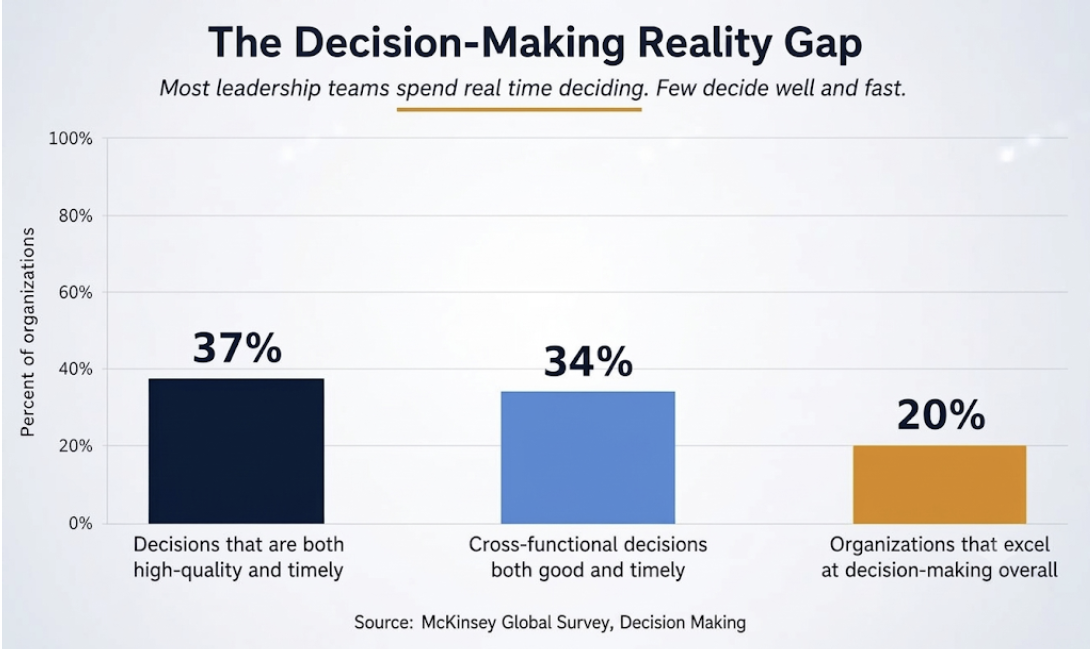
None of this proves every scaling company has a leadership problem. But it points to something worth sitting with: the organizations winning at growth aren't the ones with more meetings. They're the ones with clear practices around roles, accountability, and decision process.
That distinction decision architecture versus decision effort is where this stage of scaling is actually won or lost.
This is a documented pattern, not a personal failure
What Nadia is feeling isn't new, and it isn't a flaw in how she leads. Larry Greiner's research on organizational growth, first published in Harvard Business Review in 1972 and still one of the most cited models in the field, found that companies move through predictable phases of growth and each phase ends in a crisis that forces a change in how the company is led. Informal communication fails first. Then a single leader can no longer be involved in every decision. Then functional managers exist, but the founder still holds on too tightly to let them lead.
Churchill and Lewis's research on small business growth found the same pattern from a different angle: the systems, structure, and owner involvement that work at one stage of a company's life have to change at the next stage, or growth stalls. Neither study ties this to a specific revenue number. Both tie it to complexity outgrowing the system built to manage it, which is exactly what's happening as Nadia's company moves past $30 million.
Why "hire better leaders" doesn't fix it
The instinct, understandably, is to add. Add a VP. Add oversight. Add a layer of review. But Bain's 2026 CEO research found fewer than half of CEOs are confident they have the right people in the right roles, including CEOs who have already made those hires. That's the tell. The gap usually isn't talent.
A people problem is frequently an architecture problem wearing a people problem's clothes. New leaders get added into a structure that was never redesigned to hold them with the same decision rights, the same escalation habits, the same reporting lines built for a smaller, simpler company. They inherit the constraint instead of solving it.
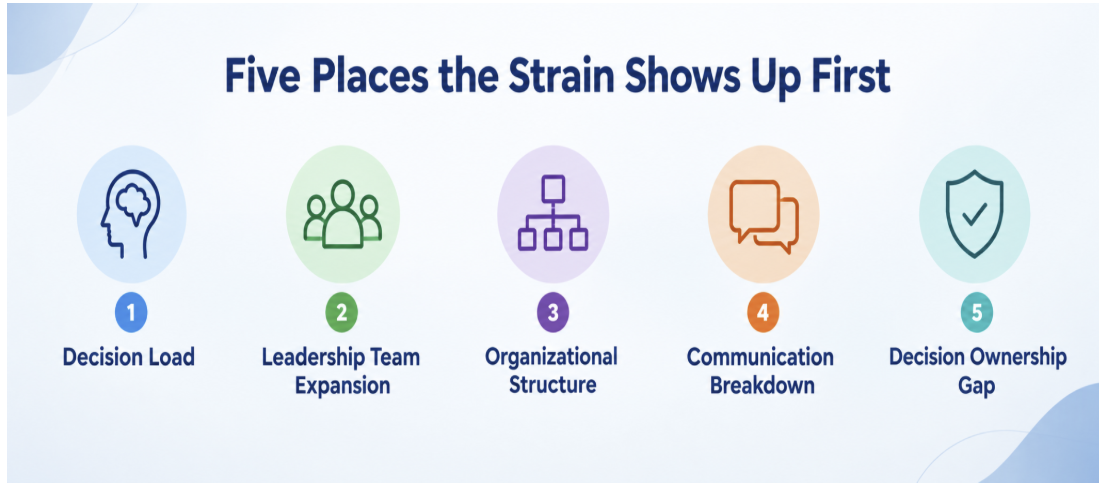
Five places the strain shows up first
Growth doesn't create these breakdowns. It exposes where the leadership architecture hasn't evolved.
1. Decision Load
Growth multiplies the number of decisions being made across the organization and more of them require cross-functional trade-offs and judgment at levels that didn't used to need it. Greiner's classic research on organizational growth found that coordination and communication problems magnify with size, not incrementally but structurally: what works at one scale becomes the constraint at the next.
What happens: the existing decision system gets overloaded.
2. Leadership Team Expansion
More leaders do not automatically mean more leadership capacity. As functions specialize, leaders naturally optimize within their own area, and enterprise-wide priorities become harder to hold together. Bain's 2026 CEO research found fewer than half of CEOs are confident they have the right people in the right roles, and most describe governance as too slow for the pace they need.
What happens: leadership becomes fragmented instead of multiplied.
3. Organizational Structure
More teams create more dependencies. Decision rights become less obvious, and ownership becomes harder to trace. This is Greiner's core finding: each growth phase requires structural change, because hierarchy multiplies and jobs become more interrelated than they were designed for.
What happens: the structure that supported one stage of growth creates friction at the next.
4. Communication Breakdown
Proximity-based alignment stops creating alignment. Messages get filtered as they pass through more layers. Priorities get interpreted differently by different teams. Churchill and Lewis's research on small business growth identified this directly: informal systems that work when a company is small have to become formal systems as it grows, or the gap gets filled with assumptions.
What happens: communication becomes heavier while clarity becomes weaker.
5. Decision Ownership Gap
Decision authority stays too centralized. Leaders escalate instead of deciding, not because they lack judgment, but because they aren't clear on what they're actually empowered to own. McKinsey's research calls this "decision drift": looping approvals, quiet vetoes, decisions that technically belong to someone but functionally come back to the top.
What happens: organizational capacity becomes constrained by senior-leader capacity.
Klarna: what this looks like inside a real company
In 2018–2019, Klarna, then valued at roughly $5.5 billion and scaling aggressively into the U.S., brought in McKinsey to look at why a single marketing and sales project had been stuck for nearly two years.
The diagnosis wasn't a talent problem. It was a structure problem. The organization had been built to be comprehensible to top managers. That worked for top managers. But it left front-line teams unclear on priorities and ownership, so decisions kept moving upward and work kept stalling.
CEO Sebastian Siemiatkowski's own account of it: the prior structure worked for senior leadership, but it left the people actually doing the work without clarity on what they owned.
Klarna's fix was structural, not motivational. They rebuilt around small, cross-functional teams, 280 of them across 36 domains, with four to eight people each, modeled on Amazon's two-pizza rule and Spotify's squad structure. Each team had clear targets reviewed every six weeks, daily stand-ups, and explicit ownership of outcomes rather than tasks.
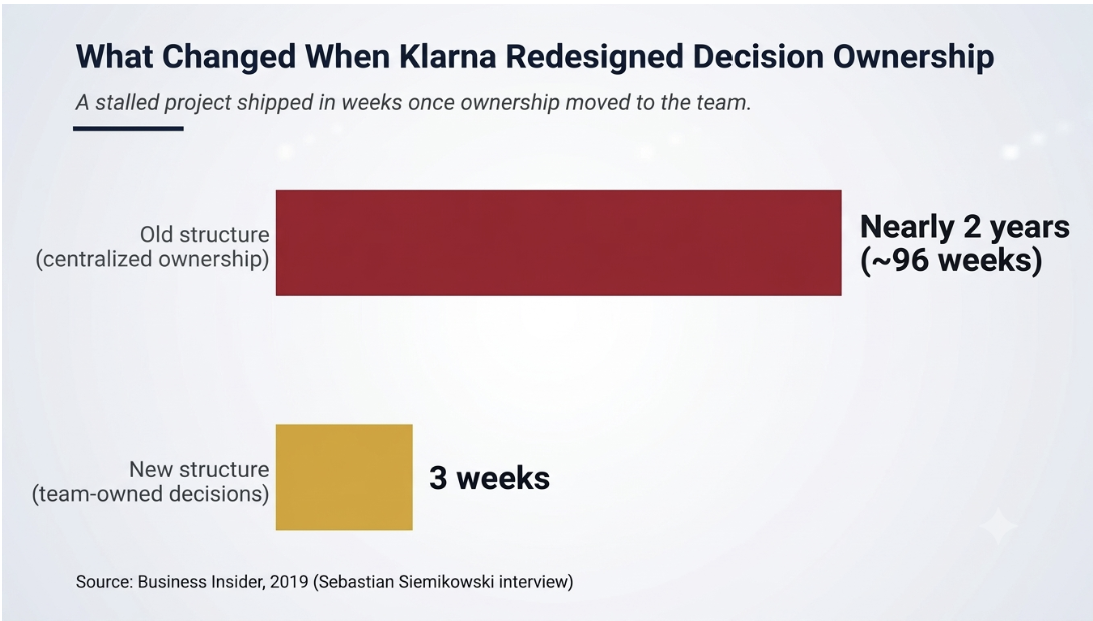
That year, Klarna reported onboarding roughly 60,000 new merchants and 16 million customers, growth the company said would not have been possible under the old structure. There was a real adjustment period, roughly nine months of lower morale as people got used to owning decisions instead of escalating them. Then execution accelerated.
Klarna didn't need a better strategy. It needed a leadership architecture that could carry the complexity the strategy was already creating.
Here's the shift
The question isn't "how do we get the CEO to carry more?"
It's "how do we build an organization that can carry more?"
That requires:
Distributed decision ownership → leaders who have the authority to make the decisions they are accountable for.
Leadership teams that operate as one → not five functions in a trench coat.
Organizational structure that matches current complexity → not last year's.
Communication systems that hold up → without depending on one leader to repeat and translate every priority.
You don't scale a company by making the CEO capable of carrying more.
You scale it by building an organization capable of carrying more.
That's the shift from leadership-dependent growth to organizational scale, and it's not a revenue milestone. It's a design decision.
Questions for your leadership teamBefore adding another layer of oversight, ask:
|
|---|
Explore More on Scaling Leadership
This article is part of our work on the Architecture of Scaling: how decision rights, authority, accountability and leadership systems must evolve as companies grow.
Explore more insights across the Psychology, Architecture and Economics of Scaling.
Sources:
Larry E. Greiner: "Evolution and Revolution as Organizations Grow," Harvard Business Review, 1972 (reprint 1998)
Neil C. Churchill & Virginia L. Lewis: "The Five Stages of Small Business Growth," Harvard Business Review, May–June 1983
McKinsey: "Decision-making in the age of urgency"
McKinsey: "Scaling up: How founder CEOs and teams can go beyond aspiration to ascent," 2022
Bain & Company: "The 2026 CEO Agenda: Where Ambition Outpaces Execution," 2026
Business Insider: "Here's how the CEO of $5.5 billion fintech startup Klarna adapted Amazon's two-pizza meeting theory," Callum Burroughs, 2019