Why Scaling Requires a New Version of the CEO
Growth doesn't just change the org chart; it changes what the CEO must believe, decide, let go of, and become.
Psychology of Scaling
Each growth threshold requires the CEO to release the version of themselves that made the last stage possible. That isn't a personal failing. It's a documented pattern, and it has a name: Identity Expansion.
By Stephanie Paillé
Founder & CEO, 360 Leadership Coaching
Let's look at Elena, the founder of a company that started as her and a laptop.
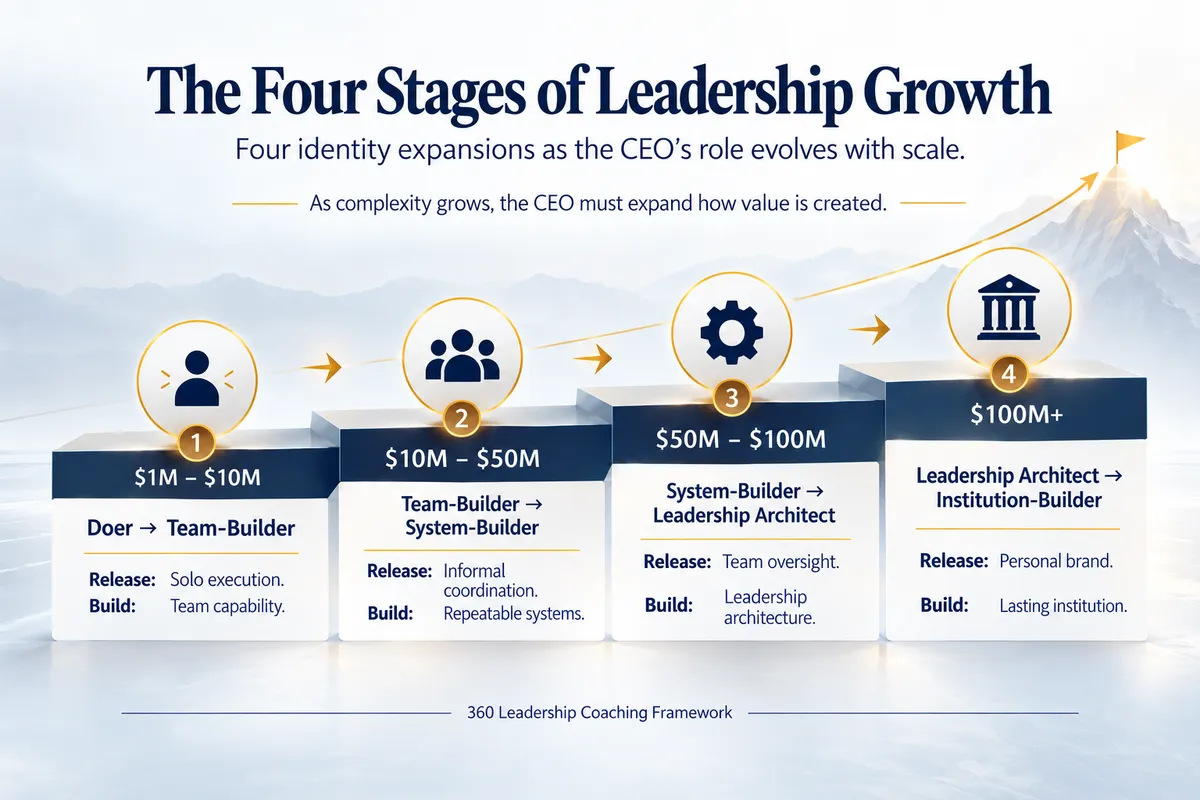
At $1 million, she is the product. She writes the code, closes the deals, answers support tickets at midnight. Her value is her output. That's not a flaw in her leadership at this stage; it's the entire company.
At $10 million, the same instincts start to cost her. She has a team now, but she still reviews everything, still makes the calls she used to make alone, still measures her worth by how much she personally touches. Decisions bottleneck. Good people get frustrated and leave not because they're mistreated, but because there's no room to actually own anything.
At $50 million, she has a leadership team. But she built the reporting lines, the meetings, the culture, around a version of herself that no longer fits the company. Her calendar is full of decisions that shouldn't require her at all. She isn't failing; she's still operating as the founder who built the product, inside a company that now needs an architect of leadership, not a builder of features.
At $100 million and beyond, the question stops being "can Elena scale?" and becomes "can the company survive without Elena?" That's a different company. It requires a different Elena, one who has stopped equating her value with being needed and started building something that outlasts her personal involvement.
Same founder. Four different jobs. Four different versions of who she has to be.
The leadership model that built the company is not the leadership model that scales it
This is where most CEOs misdiagnose the problem. They treat growth as an execution problem: more hires, more process, more hours, when what's actually required is closer to reinvention: releasing the identity that made the last stage work, and building a new one.
The real question at each threshold isn't "how do we grow more?"
It's "who do I have to become for this company to outgrow me?"
The evidence:
Success creates a new leadership threshold
The pattern doesn't stop as companies get larger. If anything, the thresholds become more demanding. Reaching $1 billion is already an extraordinary achievement. But Identity Expansion doesn't end there. Every new level of scale creates another point where the founder's role, instincts and definition of value have to evolve again.
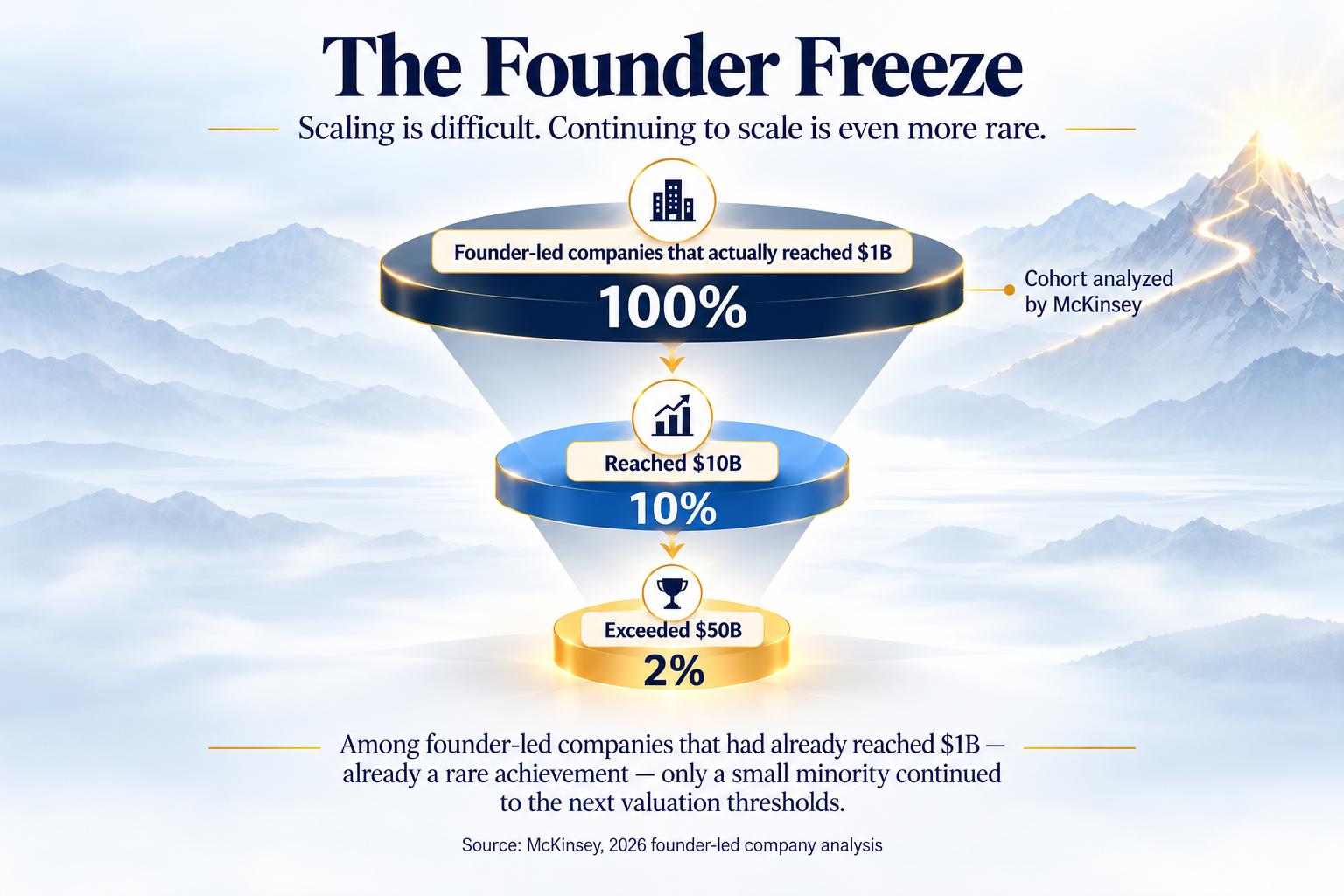
McKinsey's 2026 analysis of more than 2,700 founder-led companies looked at what happens at that institutional level. Among founders whose companies had already reached a $1 billion valuation, only about 10% went on to build a $10 billion company, and fewer than 2% exceeded $50 billion. Most don't fail from a bad idea. They freeze in the $1–10 billion range as complexity rises and the instincts that built the company become constraints on what it can become next.
The pattern shows up earlier too, as CEO turnover. Research on founder transitions found that as founders successfully reach major milestones, the probability that they will eventually be replaced as CEO can actually rise, what Noam Wasserman calls the “paradox of entrepreneurial success.” Success increases complexity, raises expectations and changes what the role requires.
None of this proves every founder is destined to be replaced. But it points to something worth sitting with: the skill that gets a company through one growth threshold is rarely the skill that gets it through the next. The company changes, and eventually the CEO has to change with it.
Founder-CEOs make the pattern especially visible because their identity is often deeply intertwined with the company they created. But the underlying leadership challenge is broader: professional CEOs also inherit roles, habits and definitions of value that can become constraints as the company enters a new stage.
This is a documented pattern, not a personal failure
What Elena is feeling isn't new, and it isn't a flaw in how she leads. Larry Greiner's research on organizational growth, first published in Harvard Business Review in 1972 and still one of the most cited models in the field, found that companies move through predictable phases, and each phase ends in a crisis that forces a change in leadership style. Creativity gives way to a crisis of leadership. Direction gives way to a crisis of autonomy.
Delegation gives way to a crisis of control. Each solution becomes the next constraint, and Greiner noted that resistance is often highest at the top, because the leader's identity and authority are tied to the very structure that's now failing.
More recent research names the mechanism directly. A 2023 study in the Journal of Business Venturing found that founder roles evolve through deliberate "role-crafting" as companies scale, and because those roles become part of the founder's identity, relinquishing them is harder than the org chart suggests.
Taken together, that research points toward a deeper Scaling CEO interpretation: as the company changes, the leader's role changes with it. And because roles become tied to identity, relinquishing the behaviors that created earlier success can be harder than changing the org chart. The constraint is not always capability. Sometimes, it's identity.
Why "work harder" and "just delegate more" don't fix it
The instinct, understandably, is to add: add hours, add a layer of review, add a delegation framework, add a coach for better habits. But if the real gap is identity, not skill, none of those fixes reach it.
A founder can be taught to delegate a task without ever releasing the belief that their value depends on being the one who's needed. That belief doesn't show up on a to-do list. It shows up as decisions that quietly route back to them anyway, as new hires who never quite get full ownership, as a leadership team that's technically empowered and functionally still waiting for permission.
Skill training changes what a CEO can do. Identity Expansion changes what a CEO believes is theirs to hold onto.
Four identity shifts that often emerge as companies scale
Growth doesn't ask a CEO to do the same job better. It asks them to take on a different job repeatedly.
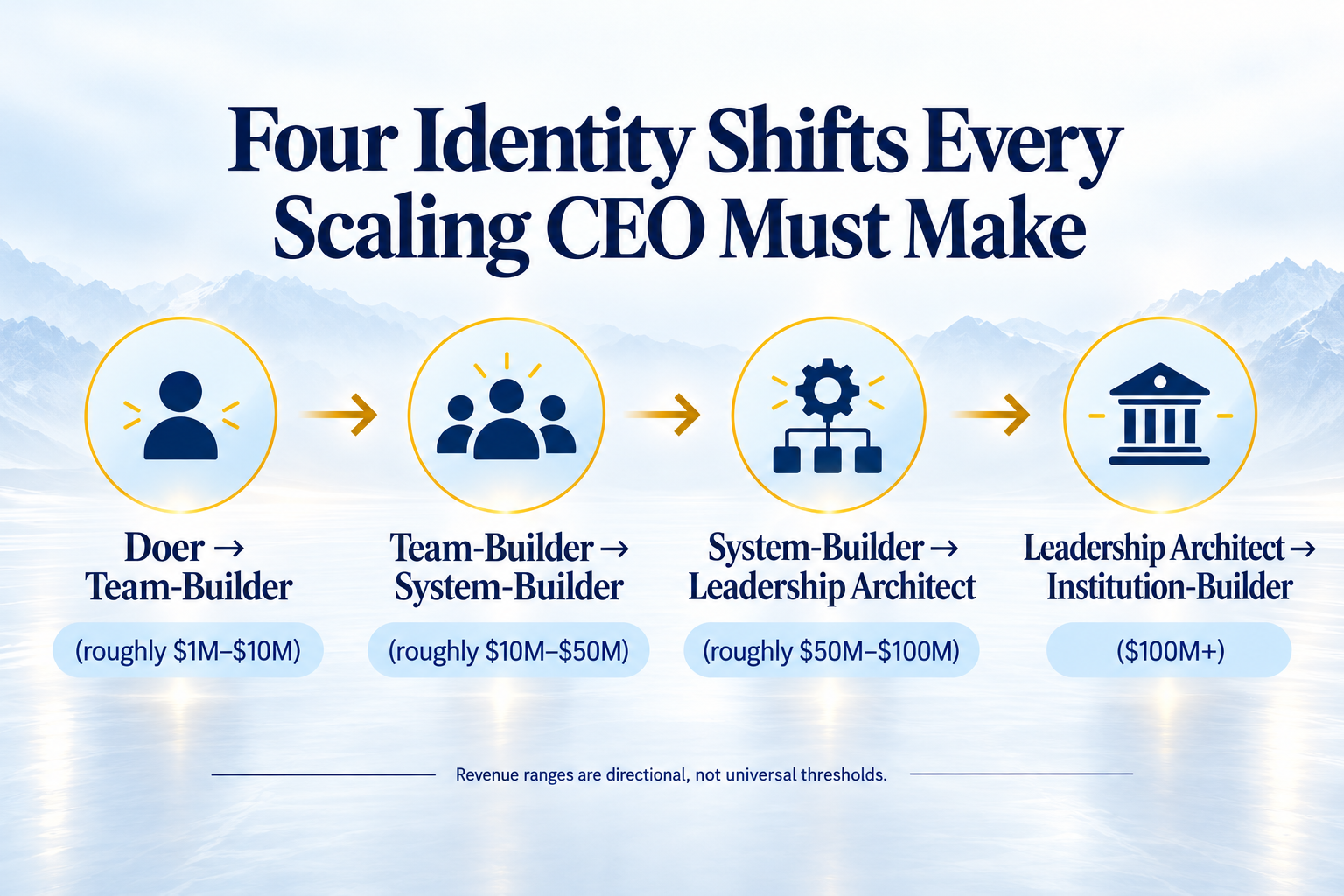
The revenue ranges below are directional, not universal thresholds. The underlying shift matters more than the number.
1. Doer → Team-Builder (roughly $1M–$10M)
Value shifts from personal output to building the capability of others.
Release: “I am the person who does the work.”
Build: “I am the person who builds the people who do the work.”
2. Team-Builder → System-Builder (roughly $10M–$50M)
A capable team is no longer enough. As complexity grows, the company needs repeatable systems, clearer roles, stronger operating rhythms and ways of working that don't depend on the CEO or a few key individuals to keep everything connected.
Release: “Our best people are what keep the company running.”
Build: “Our systems allow capable people to operate with clarity, consistency and less dependency on a few individuals.”
3. System-Builder → Leadership Architect (roughly $50M–$100M)
Systems can carry repeatable work, but growing complexity now requires leadership capacity across the organization. Decision rights, authority, accountability and leadership layers have to become deliberately designed so judgment can move beyond the CEO.
Release: “My oversight is what keeps the organization aligned.”
Build: “I design the leadership architecture that allows other leaders to carry decisions, accountability and complexity.”
4. Leadership Architect → Institution-Builder ($100M+)
The company is no longer simply scaling through people and systems. It has to become an institution capable of preserving its standards, culture and performance beyond any one leader's presence.
Release: “This company is an extension of me.”
Build: “I am building an institution designed to outlast me.”
Each shift requires giving up the very thing that made the CEO successful at the previous stage. That's what makes it hard. It's also what makes it necessary.
Shopify: what this looks like inside a real company
Tobi Lütke's own account of Shopify's post-IPO years is a specific, public example of what happens when a founder adopts an identity that doesn't fit the company and what it takes to correct it.
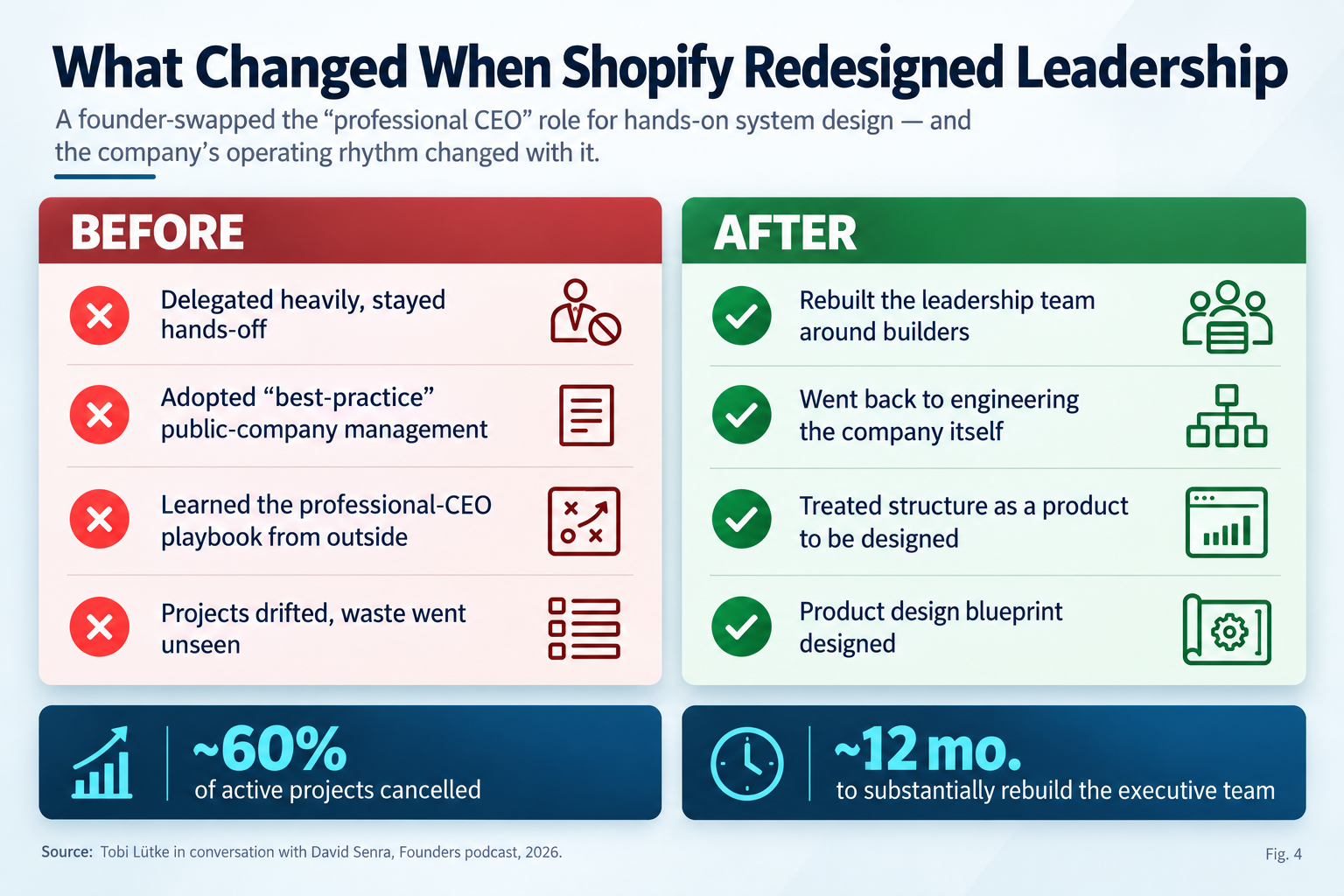
As Shopify scaled, Lütke describes stepping into what he later called "cosplaying" the role of a traditional public-company CEO: delegating heavily, staying hands-off, adopting management best-practice theater. It looked like the professional thing to do. It also meant projects drifted, waste accumulated, and decisions got made that he should have been part of.
The correction wasn't a new org chart. It was a new identity. Lütke reviewed every active project and cancelled roughly 60% of them. He rebuilt his executive team over roughly a year with people who thought and built like founders. He stopped performing the "professional CEO" role and went back to engineering the company itself, treating Shopify's structure and processes as a product to be designed, not a set of best practices to be adopted.
The lesson isn't "founders should never delegate." It's that the identity has to match what the company actually needs at its current stage, and that match has to be actively re-chosen, not assumed to hold just because it worked before.
Here's the shift
The question isn't "how do I become a CEO who can carry more?"
It's "what version of me does this company need next, and what version am I still protecting?"
You don't scale a company by becoming a better version of the CEO who built it. You scale it by becoming the CEO the next stage actually requires, even when that means releasing the identity that got you here.
That's Identity Expansion. It isn't a soft-skills exercise. It's the personal side of the same transformation that shows up on the org chart as new structure, new decision rights, and new leadership capacity. The architecture can't hold if the identity behind it hasn't changed.
Questions for your leadership teamQuestions to sit with, honestly, before your next leadership offsite:
|
|---|
Explore More on Scaling Leadership
This article is part of our work on the Psychology of Scaling: how judgment, identity, conviction and decision-making evolve as the stakes of leadership grow.
Explore more insights across the Psychology, Architecture and Economics of Scaling.
Sources:
Larry E. Greiner, "Evolution and Revolution as Organizations Grow," Harvard Business Review, 1972 (reprint 1998)
Noam Wasserman, "The Founder's Dilemma," Harvard Business Review, Feb 2008
Noam Wasserman, The Founder's Dilemmas: Anticipating and Avoiding the Pitfalls That Can Sink a Startup (Princeton University Press, 2012)
McKinsey & Company, "Will you fly or freeze? How founders can build enduring companies beyond $10 billion," July 17, 2026
Evy Van Lancker et al., "Preparing for scaling: A study on founder role evolution," Journal of Business Venturing, 2023
Eric G. Flamholtz & Yvonne Randle, Growing Pains: Building Sustainably Successful Organizations, 5th ed. (Wiley)
Supporting summary
Tobi Lütke, in conversation with David Senra, Founders podcast (2026). Lütke's own "cosplaying as a CEO" account, timestamped
Full episode