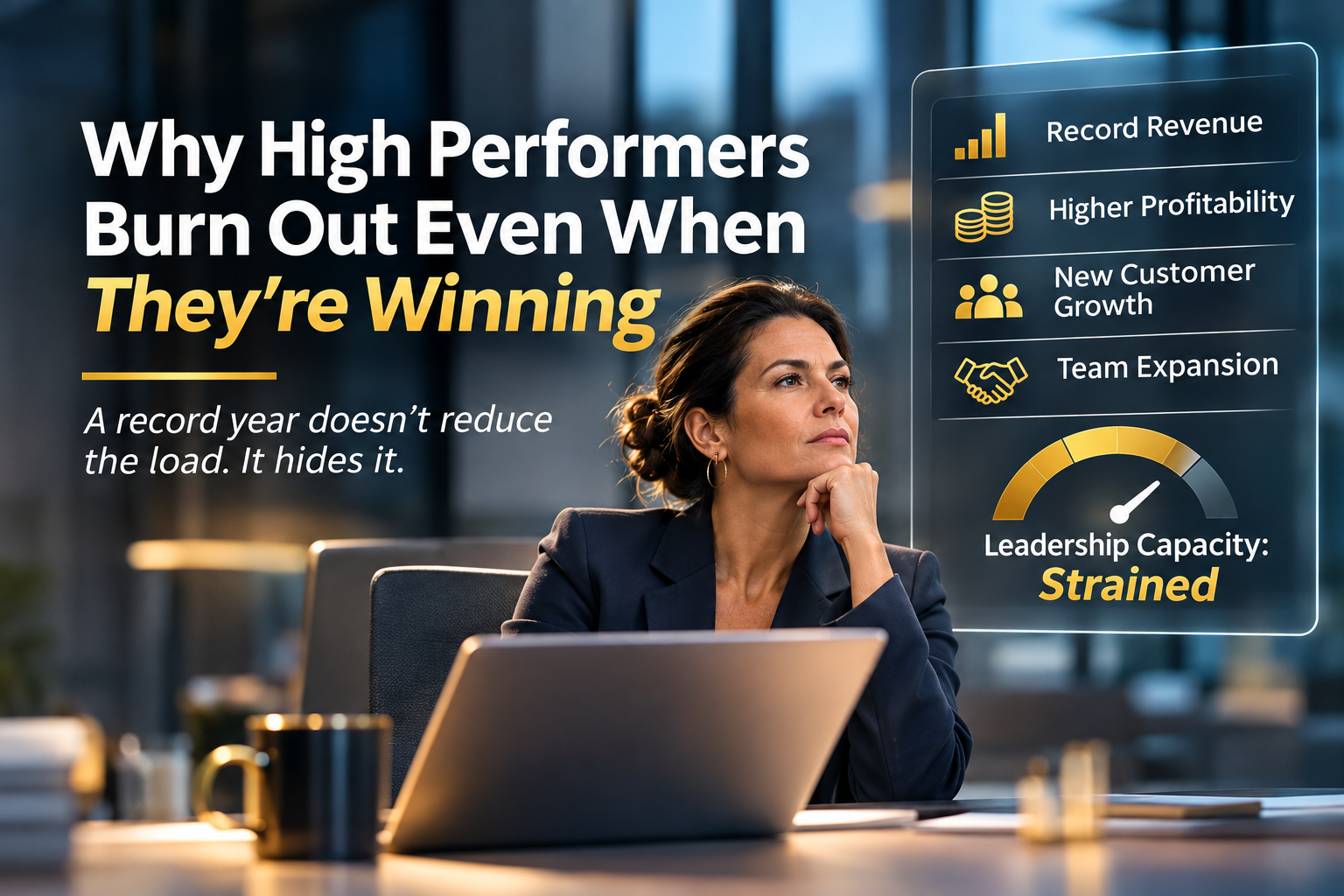
Why High Performers Burn Out Even When They're Winning: Success Load
A record year doesn't reduce the load. It hides it.
Burnout in a scaling company rarely starts in a bad quarter. It starts in a good one, when success adds load faster than the leadership system is redesigned to carry it, and quietly removes the signals that would normally force a reset. That isn't simply a resilience problem. Through the Scaling CEO lens, I think of it as Success Load: the load that accumulates from winning faster than the leadership system is redesigned to carry it.
By Stephanie Paillé
Founder & CEO, 360 Leadership Coaching
Let's look at Camille, the CEO of a $38 million B2B services company.
In the first quarter, the company signs two new enterprise clients. Camille takes the lead on both relationships herself. They're too important to hand off, and besides, she's the one they bought.
In the second quarter, headcount grows by forty people. Every hiring decision routes through Camille or Nadia, her VP of Operations and the strongest leader she has. Nadia starts taking calls at 7 a.m. and closes her laptop at 10 p.m. Nobody worries. Nadia has always been like this. It's why she's so good.
In the third quarter, a new service line launches. Theo, who runs client delivery, absorbs it "for now," because Theo is the one who always figures things out. Camille cancels her week off in August. Just this once. The timing is terrible.
In the fourth quarter, the company closes the best year in its history. Revenue is up 31%. The board congratulates her. Nadia has missed two things this month she would never have missed a year ago. Theo has started saying "fine" in leadership meetings to proposals he used to push back on. And Camille is more exhausted than she has ever been, and cannot name a single thing she would stop doing.
Nobody asked what the year cost. Not the board. Not the leadership team. Not Camille.
She isn't weak. Her leaders aren't fragile. They are carrying a company that grew 31% on a leadership system that didn't grow at all.
The effort that built the company is not the capacity that scales it
This is where most CEOs misdiagnose the problem. They treat burnout as a question of personal stamina, and they reach for personal fixes: take a real vacation, set better boundaries, bring in a resilience program, hire a coach to help the leadership team manage their energy.
None of those are wrong, exactly. They're aimed at the wrong layer.
In a winning company, burnout is often a design problem that shows up in people. The load keeps growing. The structure carrying it doesn't. And because the results are strong, nobody goes looking for the gap until a key leader goes quiet, makes an uncharacteristic mistake, or resigns.
The real question isn't "how do we help our best people cope with this pace?"
It's "why is so much of this growth landing on the same few people, and why did nobody see it while the numbers were good?"
The evidence: Exhaustion at the top is now a condition of the job
In a May 2025 WSJ/Vistage survey of nearly 500 small-business CEOs, 94% said they had experienced burnout symptoms at least once in the past year. Nearly a third (32%) said they felt exhausted or burned out regularly: 25% frequently, and 7% every day. Among the recurring stressors was overload: carrying too many objectives and too much responsibility, with too little ability to put any of it down.
The pattern holds further up the market. BCG's CEO Insomnia Index, based on a January 2026 survey of roughly 500 CEOs at companies with $100 million to more than $5 billion in revenue, put average job-related stress at 66.7 out of 100, with more than 70% of CEOs reporting high stress levels. The single biggest source of that stress wasn't a crisis. It was meeting growth targets. The senior leadership team ranked among the three most stressful stakeholder groups. And BCG found that as emotional exhaustion rises, recovery from intense stress slows down.
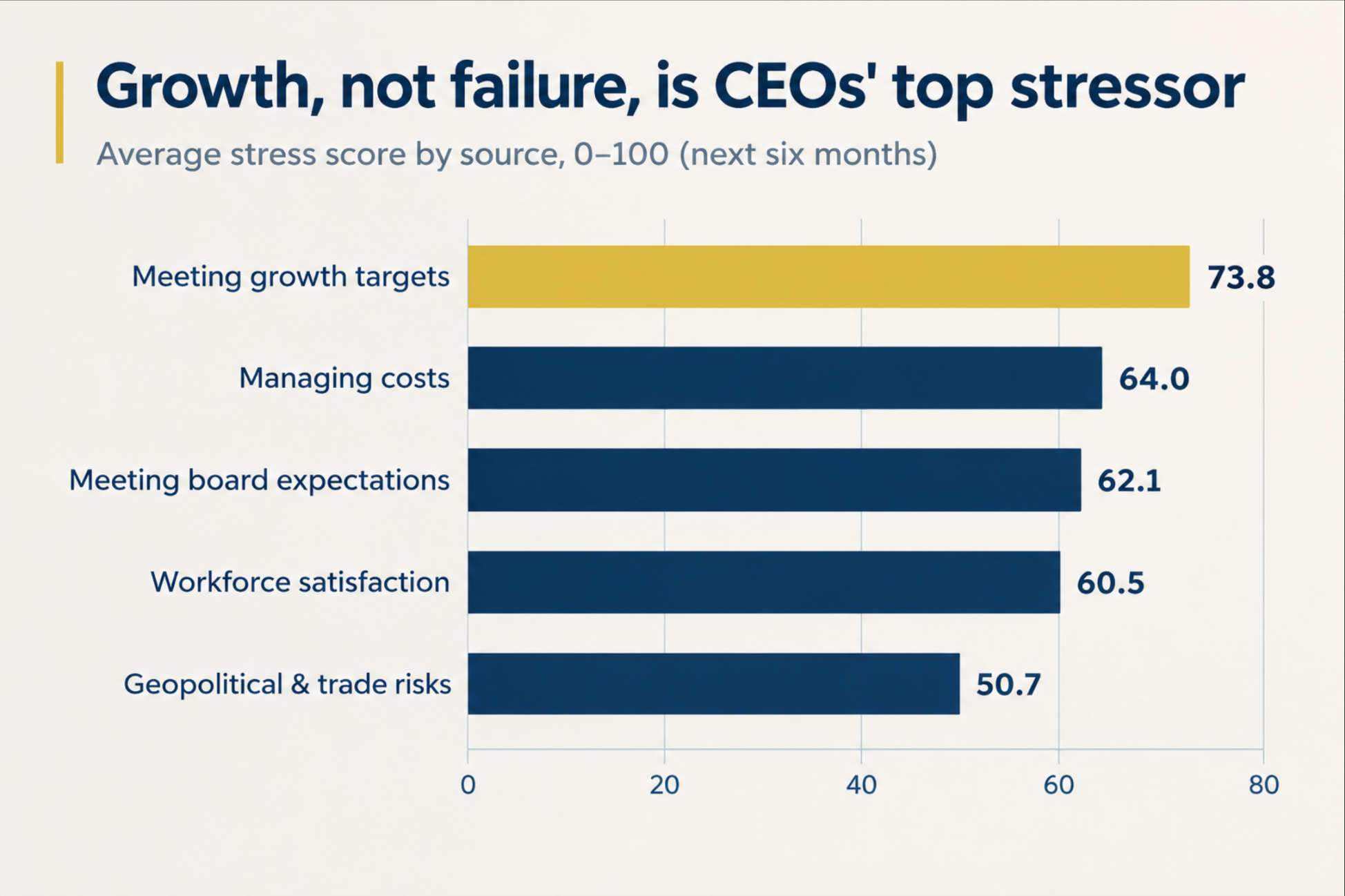
Read those findings together and something stands out. The pressure isn't coming primarily from failure. It's coming from growth: from hitting the number, not missing it.
None of this proves that every CEO is burning out, or that growth alone causes it. Both surveys are self-reported, and neither isolates high-growth years specifically. But it points to something worth sitting with: at the top of growing companies, exhaustion has become common enough to be treated as part of the job. And what gets treated as part of the job gets normalized, not designed for.
This is a documented pattern, not a personal failure
What Camille and her leaders are experiencing isn't a character flaw, and the research has been unusually clear about where it comes from.
The World Health Organization classifies burnout as an occupational phenomenon, not a medical condition. Its definition is precise: burnout results from chronic workplace stress that has not been successfully managed, and it shows up in three ways: exhaustion, growing mental distance or cynicism about the work, and reduced professional effectiveness. The definition locates burnout in how work is carried out, not in who is carrying it.
Christina Maslach and Michael Leiter, whose research shaped how burnout is measured, describe it as a mismatch between the person and the job across six areas of worklife: workload, control, reward, community, fairness, and values. Workload is the most intuitive of the six, and the most relevant to a growing company: when the demands of a role outrun the capacity to meet them for long enough, exhaustion follows.
The Job Demands-Resources model, first published by Evangelia Demerouti, Arnold Bakker and colleagues in 2001 and replicated extensively since, makes the mechanism explicit. Job demands drain energy. Job resources (support, clarity, authority, capacity) replenish it and buffer the strain. Burnout develops when demands keep rising, and resources don't keep pace.
That is a growth year described in one sentence. Demands up 31%. Resources roughly where they were.
To be fair to the evidence, individual factors matter too. Johannes Siegrist's research on effort and reward identified overcommitment, an inability to withdraw from work obligations, as an independent risk factor. Robert Vallerand's research on passion found that people whose passion for their work becomes obsessive are more vulnerable to burnout than those whose passion stays in balance with the rest of their lives.
But notice what scaling companies tend to reward: overcommitment and obsessive dedication. The traits that raise a person's risk are the same traits that get them promoted, trusted, and handed more.
Why "build more resilience" doesn't fix it
The instinct, understandably, is to strengthen the person. A wellbeing app. A mindfulness program. Resilience training for the leadership team. A firm instruction to take the vacation this time.
The evidence on that approach is sobering. A 2024 Oxford study by William Fleming, drawing on more than 46,000 workers across 233 UK organizations, found that employees who participated in individual-level wellbeing programs, including resilience training, mindfulness, stress management and wellbeing apps, were no better off on measures of wellbeing than colleagues who didn't. The study is cross-sectional, so it can't prove such programs never help. But it is a large sample, and the finding was consistent.
A meta-analysis published in JAMA Internal Medicine in 2017 compared the two approaches directly. Across 19 studies and 1,550 physicians, interventions directed at the organization (workload, scheduling, team structure, how work was designed) produced an effect roughly two and a half times larger than interventions directed at the individual. The population is physicians, not executives. But the direction is the same as everything else in this research: changing the load works better than strengthening the people carrying it.
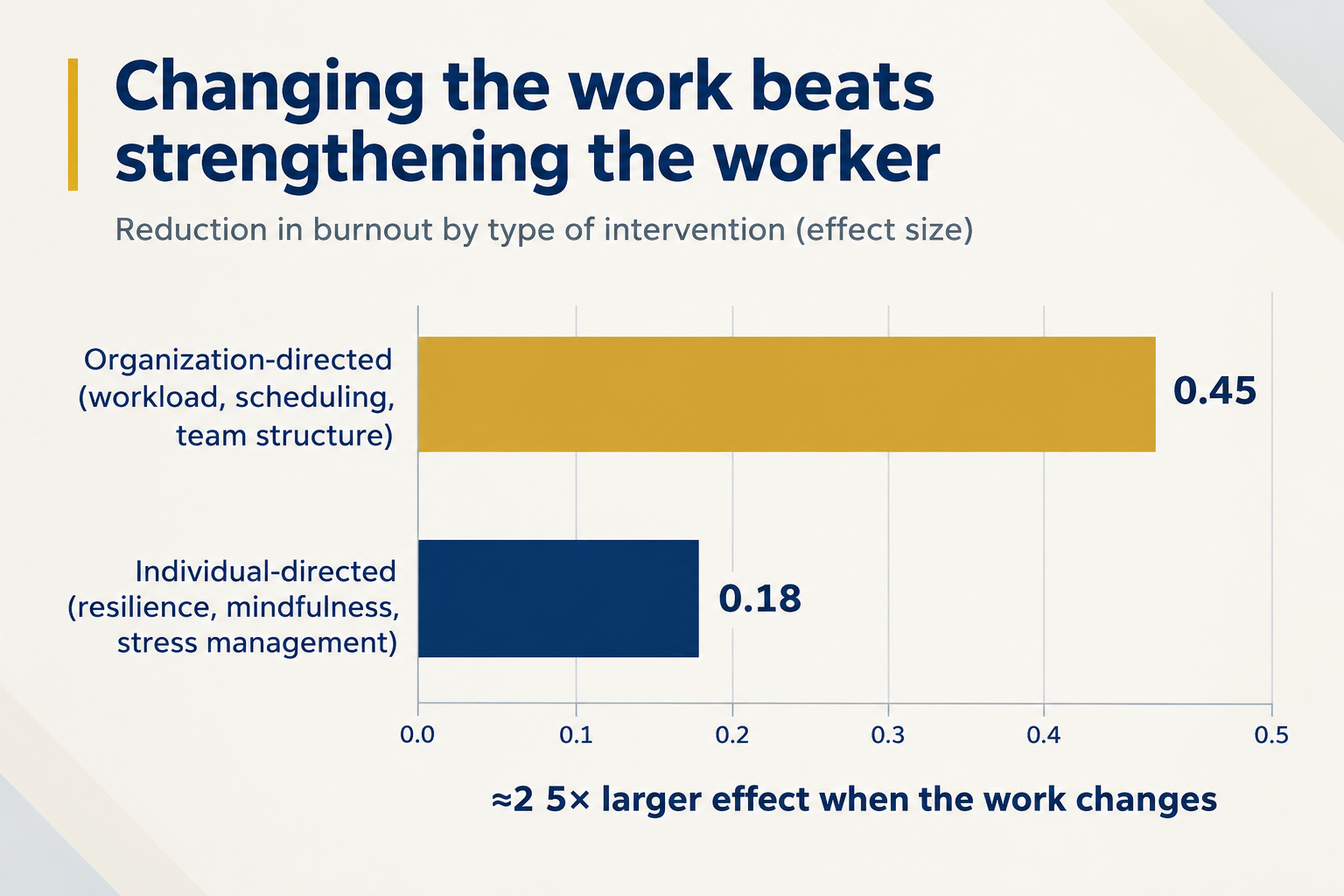
Resilience training asks people to carry the load better. It never asks why the load keeps landing on them.
And rest, however necessary, has the same limit. A vacation restores the person. It doesn't change the load they come back to.
Four ways winning hides Success Load
Success doesn't create burnout on its own. It creates the conditions under which load accumulates without anyone noticing, including the people carrying it.
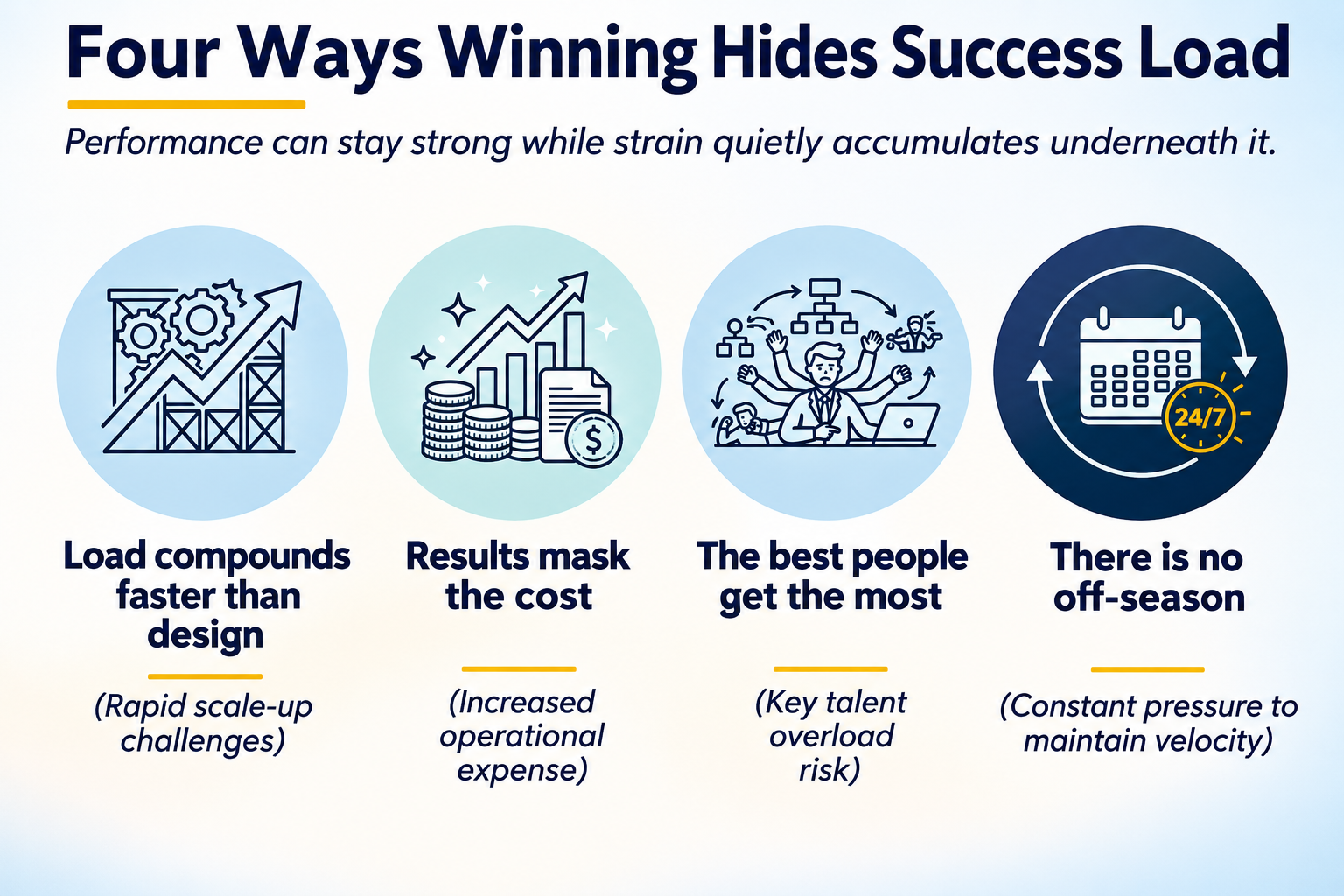
1. Load compounds faster than design
Growth adds clients, people, decisions, and dependencies, and most of it lands on the same handful of leaders who were already central. Roles, decision rights, and structure get redesigned once a year if they're lucky. The growth happens every week.
What happens: the org chart says the company has grown. The calendars of the top five people say it hasn't.
Release: "We'll fix the structure after this push." Build: "Every step of growth comes with a capacity redesign, not after it."
2. Results mask the cost
In a bad quarter, the board asks hard questions and the leadership team examines how work is getting done. In a record quarter, almost nobody asks. Strong numbers get read as proof that the system is working, even when the system is a few people running well past their capacity.
There is little research that measures this masking effect directly. But it is visible in how most companies run their reviews: the scrutiny is triggered by underperformance, and a winning year rarely triggers anything at all.
What happens: the warning signs appear in the leadership team long before they appear in the P&L, and nobody is looking there.
Release: "The numbers will tell us if something's wrong." Build: "We measure what the year cost, not just what it produced."
3. The best people get the most
New research from Kaitlin Woolley of Cornell and Sangah Bae of Northeastern, published in Organization Science in 2026, tested how managers hand out extra work. Across five main studies, managers consistently gave additional tasks to their most intrinsically motivated employees, based on two assumptions: that motivated people would enjoy the extra work more, and that they were less likely to burn out. Both assumptions were wrong. Motivated employees didn't enjoy unrelated tasks any more than anyone else, and they carried the same burnout risk. Meanwhile, the extra work cut into their primary responsibilities. As Woolley put it, "Enthusiasm should not be treated as an infinite resource."
Notably, the fixes that worked in the research were structural: making assignment decisions in batches rather than one at a time, and correcting managers' beliefs about burnout risk.
What happens: the most capable leaders become the default destination for every problem that doesn't have an owner yet.
Release: "Give it to Nadia, she'll figure it out." Build: "Unowned work gets an owner by design, not by default to whoever is most reliable."
4. There is no off-season
A setback forces a pause. A winning streak never does. Sabine Sonnentag and Charlotte Fritz's research on recovery found that high job demands make it harder for people to mentally detach from work, and that a lack of detachment is one of the pathways through which demands turn into exhaustion. BCG's finding that recovery slows as exhaustion rises adds the uncomfortable part: the longer the run continues, the harder it becomes to recover from it.
What happens: the vacation gets cancelled just this once, every quarter.
Release: "We'll slow down when things calm down." Build: "Recovery is built into the operating rhythm, because things won't calm down on their own."
How it travels through the leadership team
Success Load rarely stays with the CEO.
Research on what organizational psychologists call crossover, including work by Arnold Bakker, Mina Westman, and Hetty van Emmerik, has documented that strain transfers between people who work closely together, through empathy, through modelling, and through how people treat each other under pressure. A CEO running past capacity sets the pace for everyone who reports to her. When she cancels her vacation, her leaders learn that vacations are optional. When she answers at 11 p.m., she sets the response standard.
And because extra work flows toward the most motivated people, the strain lands first on the leaders the company can least afford to lose. They don't usually underperform visibly. They absorb, and absorb, and then something gives.
The current runs both ways. In BCG's research, the senior leadership team ranked among the CEO's top three sources of stress. A leadership team carrying too much creates more escalations, more firefighting, and more pressure on the CEO, which the CEO then passes back down.
There is a personal layer here as well. Many CEOs hold load they no longer need to hold because their sense of value is tied to being the one who handles it. That is the work of Identity Expansion, and it matters. This article is about the other half: the load itself, and why no one redesigns it while the company is winning.
Semco: what this looks like inside a real company
In the early 1980s, Ricardo Semler took over his father's Brazilian manufacturing company at 21 and set out to grow it: raising capital, pursuing acquisitions, and working from 7:30 a.m. to midnight. At 25, while touring a pump factory in Baldwinsville, New York, he collapsed on the shop floor. Tests at the Lahey Clinic in Boston found nothing physically wrong. The diagnosis, as Semler recounts in his book Maverick, was an advanced case of stress, along with a blunt warning that the pace he was keeping would not hold.
The obvious response would have been personal: work less, rest more. Semler did change his own habits. But what made Semco one of the most studied companies of its era was what came next. Over the following years, he redesigned the company so that it no longer depended on a few people carrying everything. Semco collapsed twelve layers of hierarchy into three, cut supervisory roles by roughly three-quarters, pushed decisions down into business units, let employees set their own schedules, and had managers evaluated by the people who reported to them.
The company kept growing. In the six years leading up to 2004, Semco's revenue rose from $35 million to $212 million, with employee turnover reported at around 1%.
The lesson isn't "copy Semco." Its model was radical, and most growing companies don't need anything close to it. The lesson is where Semler located the problem. He didn't treat his collapse as a failure of stamina. He treated it as evidence that too much of the company was running through too few people.
Rest restored the founder. Redesign changed what the company asked of him.
Here's the shift
The question isn't "how do our best people keep up with this pace?"
It's "what is this growth costing the people carrying it, and what have we redesigned to carry it instead?"
You don't prevent burnout in a winning company by building tougher people. You prevent it by building a leadership system that grows as fast as the company does, so that success stops landing on the same few shoulders.
That's Success Load: the load that accumulates from winning, faster than the leadership system is redesigned to carry it. It isn't a wellness topic. It's a capacity question, and it belongs on the same agenda as the growth plan that created it.
Questions for your leadership teamBefore you plan next year's growth, ask:
|
|---|
Explore More on Scaling Leadership
This article is part of our work on the Psychology of Scaling: how judgment, identity, conviction and decision-making evolve as the stakes of leadership grow.
Explore more insights across the Psychology, Architecture and Economics of Scaling.
Sources:
World Health Organization: "Burn-out an 'occupational phenomenon': International Classification of Diseases," ICD-11 (QD85), 2019
Vistage: "Managing CEO stress" (WSJ/Vistage Small Business CEO Survey, May 2025, nearly 500 small-business leaders), June 2025 Boston Consulting Group: "The BCG CEO Insomnia Index: Understanding CEO Pressure," April 2026 (survey of ~500 CEOs, January 2026)
Boston Consulting Group: "How Intense is CEO Pressure Right Now?" (Insomnia Index collection), 2026
Boston Consulting Group: "CFOs Emerge as CEOs' Top Threat to Job Security As Internal Pressures Intensify," press release, April 1, 2026
Michael P. Leiter & Christina Maslach: "Areas of Worklife: A Structured Approach to Organizational Predictors of Job Burnout," Research in Occupational Stress and Well-being, Vol. 3, 2003
Evangelia Demerouti, Arnold B. Bakker, Friedhelm Nachreiner & Wilmar B. Schaufeli: "The Job Demands–Resources Model of Burnout," Journal of Applied Psychology, 2001
Johannes Siegrist: "Adverse Health Effects of High-Effort/Low-Reward Conditions," Journal of Occupational Health Psychology, 1996 Robert J. Vallerand, Yvan Paquet, Frederick L. Philippe & Julie Charest: "On the Role of Passion for Work in Burnout: A Process Model," Journal of Personality, 2010
William J. Fleming: "Employee Well-being Outcomes from Individual-level Mental Health Interventions: Cross-sectional Evidence from the United Kingdom," Industrial Relations Journal, 2024
Maria Panagioti et al.: "Controlled Interventions to Reduce Burnout in Physicians: A Systematic Review and Meta-analysis," JAMA Internal Medicine, 2017
Sangah Bae & Kaitlin Woolley: "Managers Allocate Additional Tasks to Intrinsically Motivated Employees: Exploring Mechanisms, Consequences, and Solutions," Organization Science, March 2026: https://doi.org/10.1287/orsc.2023.18332
Cornell SC Johnson College of Business: "The enthusiasm penalty: Why motivated employees get overburdened," March 24, 2026:
Sabine Sonnentag & Charlotte Fritz: "Recovery from Job Stress: The Stressor-Detachment Model as an Integrative Framework," Journal of Organizational Behavior, 2015
Arnold B. Bakker, Mina Westman & I.J. Hetty van Emmerik: "Advancements in Crossover Theory," Journal of Managerial Psychology, 2009
Ricardo Semler: Maverick: The Success Story Behind the World's Most Unusual Workplace (Warner Books, 1993), pp. 54–57. Overview; Biography
eWeek: "Ricardo Semler: Set Them Free," 2004