Why Leadership Communication Breaks Down as Companies Scale
The Skill Wasn't Always the Problem. The System Underneath It Was.
Architecture of Scaling
Originally published January 2024 · Updated October 2026
Communication doesn't necessarily fail because leaders stop trying. It can fail because growth changes what communication has to carry, decide, and hold together, while the system underneath it stays largely the same.
As companies grow, the communication system that worked at one stage may no longer be enough for the next. That isn't only a soft-skills gap. It's a documented pattern in how organizations scale, and it maps directly onto what we call Alignment Systems.
By Stephanie Paillé
Founder & CEO, 360 Leadership Coaching
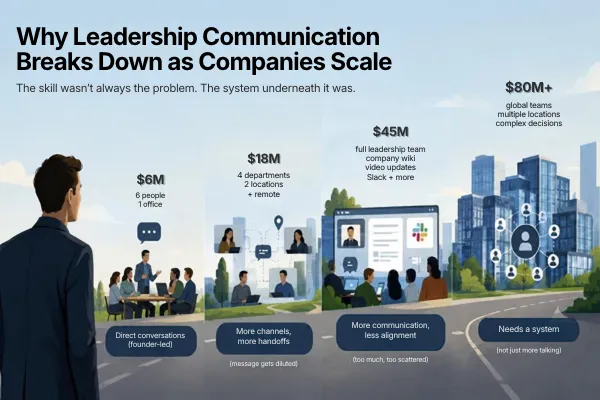
Let's look at Julian, the founder of a company that started with six people in one office.
At $6 million, Julian is in every hallway conversation, every client call, every hire. When something changes, he tells people himself, usually the same day. Nothing gets lost in translation, because there's no distance for it to travel across.
At $18 million, that same instinct starts to cost him. He still tries to deliver every update in person, but there are now four departments, two office locations, and a growing remote team. By the time a decision reaches the last person who needs it, it has passed through two other people and no longer resembles what Julian actually said. Two team leads are now executing two different versions of the same priority, both certain they heard it correctly.
At $45 million, Julian has a full leadership team, a company wiki, weekly video updates, and a Slack workspace with more channels than anyone can track. He is communicating more than he ever has, and the company feels less aligned than it did at $18 million. He isn't failing to communicate. He's still running the communication model of a founder who could personally reach everyone, inside a company where that's no longer physically possible.
At $80 million and beyond, the question stops being “how do I get better at explaining this?” and becomes “does this company have a system for how decisions and context move at all, or does everything still depend on me saying it out loud?” That's a structurally different problem. No amount of Marcus talking more, or talking better, solves it.
Same founder. Four different communication jobs. Four different systems required to carry them.
The communication style that built the company is not the communication system that scales it
This is where most leadership teams misdiagnose the breakdown. They treat it as a skills problem: a better slide template, a livelier town hall, a workshop on active listening, a coach who sharpens the CEO's delivery. None of that is wrong, exactly. It's just aimed at the wrong layer.
The real question at each threshold isn't “how do I communicate more clearly?” It's “does the reasoning behind a decision actually reach the people who need to act on it, in a form they can use, without me being in the room to deliver it personally?”
The evidence: communication breakdown is persistent and measurable
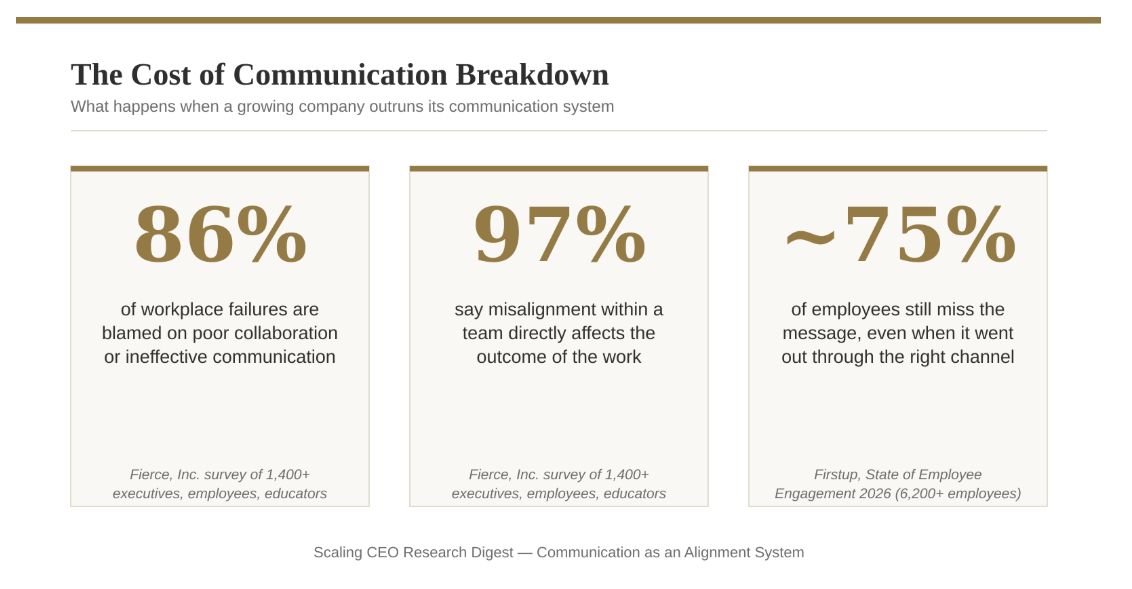
Research over the past decade has repeatedly linked communication and collaboration problems with workplace failures. A widely cited survey of more than 1,400 corporate executives, employees, and educators by leadership-development firm Fierce, Inc. found that 86% of respondents blamed a lack of collaboration or ineffective communication for workplace failures, and nearly all of them, 97%, said a lack of alignment within a team directly affected the outcome of a task or project.
Newer research shows the gap hasn't closed as communication tools have multiplied; if anything, it has become harder to see. Firstup's 2026 State of Employee Engagement research, based on a survey of more than 6,200 employees across North America and the United Kingdom, found that even when leaders use the approved channel and confirm the message went out, as many as three-quarters of employees still never absorb it.
The same research also found a disconnect between reported engagement and retention risk. Firstup framed the communication gap not simply as a content or frequency problem, but as a systems challenge.
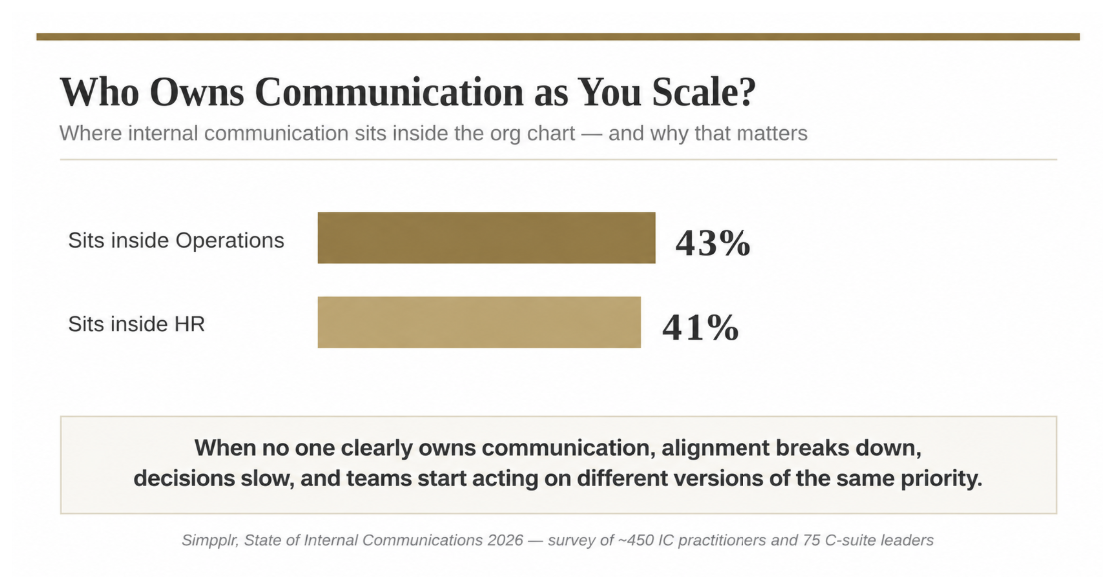
Part of why the gap persists is structural. Simpplr's State of Internal Communications 2026 research, drawn from nearly 450 internal-communications practitioners and a companion survey of 75 C-suite leaders, found that internal communication rarely stands on its own inside a company; it is most often folded into Operations or HR. Where the function sits shapes who owns it, who is accountable for it, and how seriously it is resourced as the company grows, which can blur ownership, accountability and the role communication is expected to play as the company grows.
None of this proves communication is destiny. But it points to something worth sitting with: the informal, founder-carried communication model that works cleanly at ten or twenty people doesn't simply become “less effective” as the organization grows. At some point, it may stop functioning reliably as a system, and most companies don't notice until the cost shows up somewhere else, in missed deadlines, duplicated work, or a leadership team that quietly stops trusting what it's told.
This is a documented pattern, not a personal failing
What Julian is experiencing isn't a communication deficit unique to him. It's the same pattern Greiner's research on organizational growth describes for leadership style more broadly: what works at one stage becomes the constraint at the next, and the people closest to the original success are often the last to see it, because the old model is tied to their own sense of what leadership looks like.
Communication is often one of the first places that pattern becomes visible. It's the layer every function depends on, so when it degrades, the damage shows up everywhere else before anyone traces it back to its source.
Why “communicate more” and “communicate better” don't fix it
The instinct, understandably, is to add: another update, another meeting, a more polished deck, a communications hire. But if the real gap is architectural, none of those additions reach it.
A CEO can be coached into a stronger town hall performance without ever changing whether the decisions made in that town hall reach the people three layers down in a form they can actually use. Volume changes what gets said. It doesn't change whether the system carries meaning, context, and reasoning to where they're needed, or whether it quietly depends on the CEO personally translating and re-translating the same message at every level.
Skill training changes how well a leader can perform a message. Alignment Systems change whether the organization can carry that message, and the decision logic behind it, without the leader in the room.
Four shifts every scaling communication system must make
Growth doesn't ask a company to communicate the same way, louder. It asks the communication system to do a fundamentally different job at each stage.
1. Direct Presence → Repeated Priorities (roughly $1M–$10M)
At this stage, reach comes from proximity. Release: “If it matters, I'll say it myself.” Build: “If it matters, it has to survive me not being in the room.”
2. Repeated Priorities → Decision Context (roughly $10M–$40M)
An announcement isn't understanding. Release: “Everyone heard the update.” Build: “Everyone understands the reasoning well enough to make the next ten decisions on their own.”
3. Decision Context → Structural Alignment (roughly $40M–$100M)
Personal translation gives way to designed pathways. Release: “My leadership team will pass this down accurately.” Build: “There's a system that carries context down and friction back up, whether or not I personally touch it.”
4. Structural Alignment → Institutional Voice ($100M+)
The company's communication stops depending on any one person's presence or style. Release: “This company sounds like me.” Build: “This company has a voice, a cadence, and a decision logic that hold together without my constant involvement.”
Each shift asks the CEO to give up the very thing that made their communication effective at the previous stage: their personal presence in every important conversation. That's what makes it hard. It's also what makes it necessary.
Amazon: what this looks like inside a real company
In 2004, Jeff Bezos made a change to how Amazon ran its meetings that had little to do with communication skill and everything to do with communication architecture. He banned PowerPoint from executive meetings and replaced it with a requirement: every significant discussion begins with a six-page narrative memo, read silently by everyone in the room before a word is spoken.
His stated reasoning wasn't about delivery polish. A slide deck, in his view, lets a presenter get away with a list of bullet points and lets executives interrupt before the reasoning has been laid out; a narrative memo forces the author to work through cause, effect, and trade-offs before anyone else sees it, and it forces the room to absorb the same context, in the same order, before debating it.
Notice what the fix wasn't. Amazon didn't send its executives to a presentation-skills course. It didn't ask people to communicate more warmly or more often. It changed the mechanism by which context and reasoning had to travel before a decision could be made, at any size the company grew to. That's an Alignment Systems fix, not a communication-skills fix: the company changed the mechanism by which context and reasoning moved through important discussions instead of depending on one leader's delivery.
Here's the shift
The question isn't “how do I become a clearer communicator?” It's “what has to be true structurally for context, priorities, and decision reasoning to reach the people who need them, at the size we are now, without depending on me to carry it personally?”
You don't scale alignment by becoming a better version of the founder who talked to everyone personally. You build the system that carries what that founder used to carry in conversation, and you keep redesigning it as the company outgrows the last version.
That's Alignment Systems. It isn't a communications tactic. It is the structural counterpart to a shift that also happens personally through Identity Expansion: releasing the belief that you are the mechanism, and building the mechanism instead.
Questions for your leadership teamBefore your next leadership offsite, ask:
|
|---|
Scaling creates new requirements of how a company communicates, not just how much it communicates.
Communication at scale is not only about how clearly leaders speak. It is about whether priorities, context and decision reasoning can move through the organization without depending on one person to carry them. If that is starting to break down, the issue may be less about communication skill and more about the Alignment Systems underneath it.
Explore More on Scaling Leadership
This article is part of our work on the Architecture of Scaling: how communication, alignment and decision context must evolve as companies grow.
Explore more insights across the Psychology, Architecture and Economics of Scaling.
Sources:
Fierce, Inc. — "86 Percent of Employees Cite Lack of Collaboration for Workplace Failures" (survey of 1,400+ corporate executives, employees, and educators)
Firstup — "State of Employee Engagement 2026" research (survey of 6,200+ employees across North America and the UK)
Simpplr — "State of Internal Communications 2026" (survey of ~450 internal-communications practitioners and 75 C-suite leaders)
Jeff Bezos — 2017 Letter to Amazon Shareholders (published April 2018), on Amazon's narrative-memo meeting structure
Jeff Bezos — remarks at the George W. Bush Presidential Center Forum on Leadership, April 2018, on banning PowerPoint at Amazon
Larry E. Greiner — "Evolution and Revolution as Organizations Grow," Harvard Business Review, 1972 (reprint 1998)