
Why Most AI Transformations Fail Before the Technology Does
The Real Reason Pilots Stall and Production Never Comes
Most AI initiatives don't fail because the model was wrong. They fail because the organization was never redesigned to decide anything faster than it did before AI arrived.
By Stephanie Paillé
Founder & CEO, 360 Leadership Coaching
Picture a large insurer. It spends eighteen months and seven figures teaching an AI system to read adjuster notes, flag fraud patterns, and cut settlement times. In pilot, it works. The model is accurate. The business case is real.
In production, it stalled.
Claims data lived in one division. Actuarial data lived in another. Adjusters, sensing the tool was quietly grading their judgment, stopped entering the structured notes the model needed. And when the system flagged something that crossed divisions, no one had the authority to act on it, override it, or change the workflow around it. The postmortem blamed data quality.
The real finding was different: nobody owned the decision.
That story isn't unique, and it isn't really about insurance, or fraud, or that particular model. It's a pattern showing up across many AI initiatives stalling out in 2026, and it's worth naming precisely, because "AI transformation" has become the industry's newest euphemism for a much older problem.
When AI stalls, the technology may not be the real bottleneck.
This is where most leadership teams misdiagnose what's happening. They assume a stalled AI initiative means the model needs work, the data needs cleaning, or the team needs a better vendor. So they upgrade the tool. They hire a Chief AI Officer. They run another pilot.
And then it stalls again.
Not because the technology regressed, but because the organization that received the technology was never rebuilt to carry it. AI doesn't just create new capability. It creates a faster, higher volume of decisions, options, and recommendations than most leadership structures were ever designed to process. The tool changes. The decision rights sitting underneath it don't. And that gap is where the money goes to die.
The real question isn't "which AI tool should we deploy?"
It's "can our decision-making system absorb what this tool is about to generate?"
The evidence:
This isn't a rounding error; it's the default outcome
The numbers on AI transformation failure have gotten worse, not better, as adoption has scaled.
MIT's 2025 research on the state of AI in business, drawn from roughly 300 public AI initiatives and over 50 structured interviews, found that 95% of generative AI pilots delivered no measurable P&L impact. Only about 5% reached meaningful production scale or measurable revenue acceleration.
Deloitte's 2026 enterprise survey of over 3,200 leaders across 24 countries found only 25% of organizations had moved 40% or more of their AI pilots into production. The majority are stuck in what practitioners now openly call "pilot hell."
S&P Global's 2025 enterprise survey shows the trend is moving in the wrong direction: companies aren't getting better at this; they're giving up on it faster:
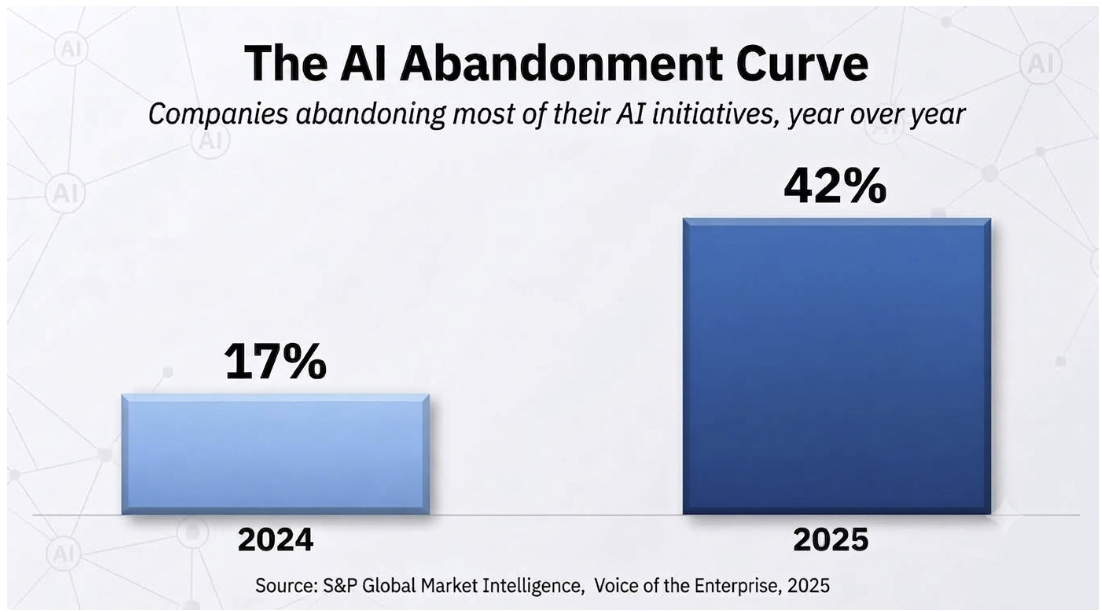
That's not a technology adoption curve. That's an organizational one.
This is a documented pattern, not a technology failure
RAND Corporation's research on AI project failure, built on interviews with 65 experienced data scientists and engineers, found the industry estimate of over 80% AI project failure is real, and traced the causes directly: miscommunication of the problem, data fragmented across silos, and a persistent over-focus on the technology itself instead of the decision the technology was meant to serve. Leadership and problem-framing failures outweighed model failures.
IBM's leadership research puts the mechanism plainly: most enterprises now split AI ownership across a CIO managing infrastructure, a CDO managing data, a CAIO managing strategy, and business leaders managing use cases, with no single framework reconciling investment, prioritization, and accountability between them. AI doesn't create that fragmentation. It just moves fast enough to expose it.
Grant Thornton's 2026 survey of nearly 1,000 executives found 78% lack confidence they could pass an independent AI governance audit within 90 days, because they cannot clearly show how AI-influenced decisions get made or who is accountable for them. Only 20% have a tested plan for what happens when an AI recommendation is wrong.
None of this is a talent problem. It's an authority problem wearing a technology costume.
Why "get a better model" doesn't fix it
The instinct, understandably, is to fix the tool. Better data pipeline. Better vendor. A more capable model. A Chief AI Officer to own the mandate.
But Grant Thornton's data shows something sharper: organizations with genuinely integrated AI meaning accountability and decision rights were addressed, not just infrastructure were nearly four times more likely to report revenue growth than those that weren't (58% versus 15%). The differentiator wasn't model sophistication. It was whether anyone had the authority to act on what the model produced.
A model problem is frequently a decision-rights problem wearing a model problem's clothes. You can swap in a better system, and it will generate better recommendations, faster, into the same unclear ownership structure, which means it fails faster, too.
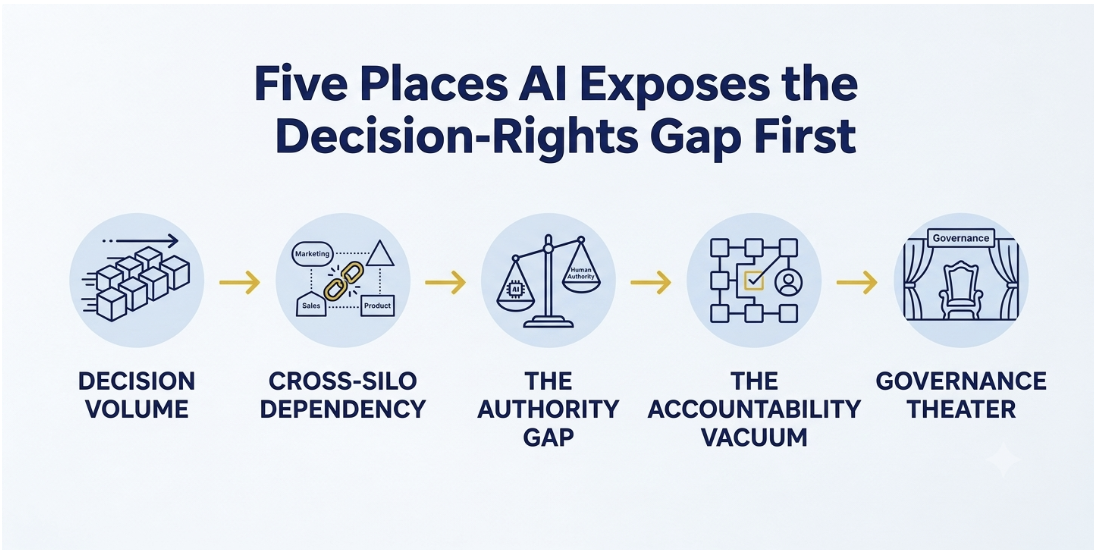
Five places AI exposes the decision-rights gap first
AI doesn't create these fractures. It finds them immediately and makes them visible at speed.
1. Decision Volume
AI increases the number of decisions and options available to the organization far faster than the number of people empowered to act on them.
What happens: recommendations pile up faster than anyone has authority to act on them.
2. Cross-Silo Dependency
AI-generated insight rarely respects org-chart boundaries; a fraud flag touches claims and actuarial; a forecast touches sales and supply chain. Legacy escalation paths were never built for outputs that cross five departments simultaneously.
What happens: the insight exists, but no single owner can act on it alone.
3. The Authority Gap
The people accountable for an AI-driven outcome frequently don't control the data definitions, the workflow, or the budget behind it. IBM names this directly: fragmented ownership across the C-suite means no one owns the full decision.
What happens: accountability is assigned without the authority to match it.
4. The Accountability Vacuum
Grant Thornton found only 1 in 5 organizations has a tested plan for when an AI recommendation is wrong.
What happens: when something breaks, there's no defined owner to correct it, so leadership absorbs the escalation by default.
5. Governance Theater
Committees, principles, and AI ethics statements are not enough. MIT CISR's 2026 research on AI decision rights argues that organizations need to explicitly design how humans and AI share responsibility for framing decisions, acting on them, and learning from the outcomes, based on the ambiguity and risk involved. Clear human accountability remains essential.
What happens: the organization believes it has governance. It has documentation.
What the data shows about the organizations that get it right
BCG's research on what it calls "AI future-built" organizations, roughly 5% of firms, found they achieved five times the revenue increases and three times the cost reductions from AI compared with other companies. The distinction is important: the firms capturing outsized value are not simply deploying more AI. They are building the organizational capabilities required to convert AI into performance, and that includes redesigning how work, accountability and decision-making operate around the technology.
McKinsey's parallel research on AI "reinventors" organizations pursuing full operating-model redesign alongside AI adoption makes the same case with a cleaner number:
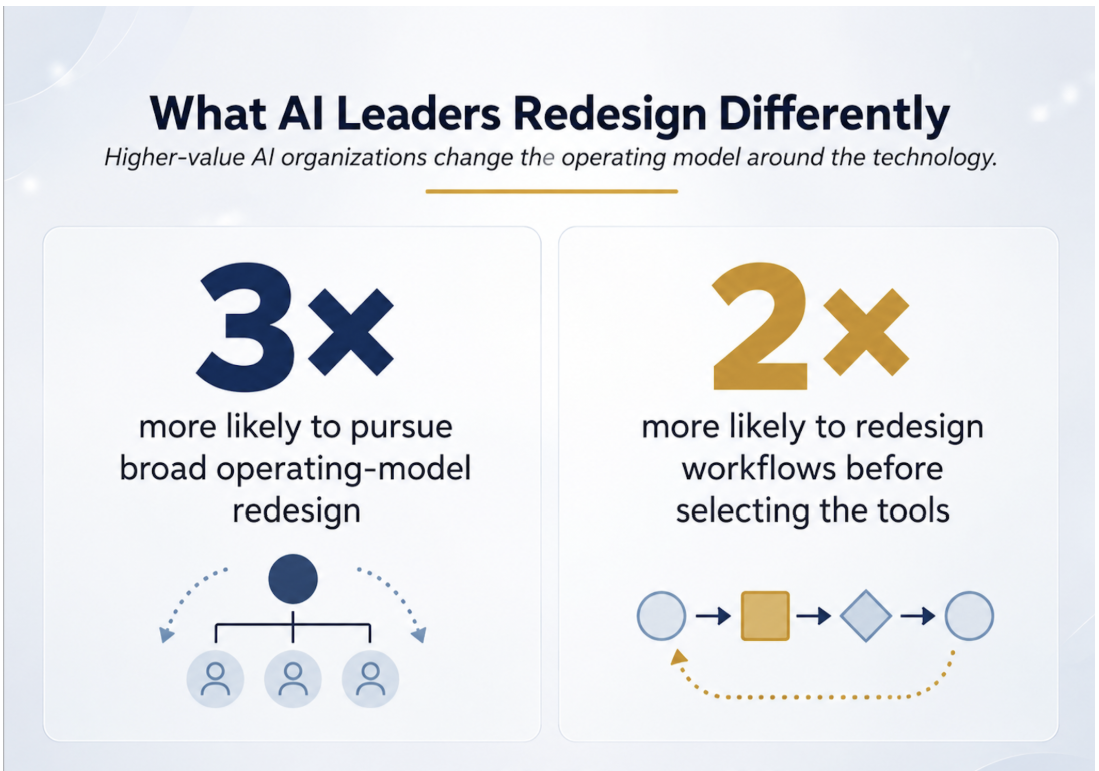
The top performers were three times more likely to pursue broad operating-model redesign and twice as likely to redesign workflows before selecting the tools.
The pattern is consistent across the research: the organizations creating more value from AI are not simply deploying better tools. They are redesigning how work happens around them. Through the Scaling CEO lens, that raises a deeper question about Decision Architecture: whether authority, accountability and decision rights have evolved enough to carry what AI now makes possible.
Here's the shift
The question isn't "how do we get more value from AI?"
It's "has the organization's decision-making system changed enough to convert what AI makes possible into real capacity?"
That requires:
Distributed decision ownership → clear authority that matches accountability, not accountability without control.
Explicit decision rights → who owns which call, under what conditions, mapped before the tool goes live.
Escalation paths built for AI's speed → not the escalation habits inherited from a slower organization.
Governance that functions, not governance that's documented
You don't get more from AI by giving the organization a smarter tool.
You get more from AI by giving the organization the authority to act on what the tool produces.
That's the shift from AI adoption to AI capacity, and it isn't a technology decision. It's a design decision.
Questions for your leadership teamBefore funding the next pilot, ask:
|
|---|
Explore More on Scaling Leadership
This article is part of our work on the Architecture of Scaling: how decision rights, authority, accountability and leadership systems must evolve as new technologies increase organizational complexity and decision speed.
Explore more insights across the Psychology, Architecture and Economics of Scaling.
Sources:
MIT NANDA / Project NANDA: "The GenAI Divide: State of AI in Business 2025," covered in Fortune, Aug 18, 2025
Deloitte: "State of AI in the Enterprise," 2026
S&P Global Market Intelligence: "Generative AI shows rapid growth but yields mixed results," Voice of the Enterprise, 2025
RAND Corporation: "The Root Causes of Failure for Artificial Intelligence Projects and How They Can Succeed," 2024
IBM Institute for Business Value: "Five Leadership Missteps to Avoid in AI," 2026
Grant Thornton: "2026 AI Impact Survey Report," 2026
Grant Thornton: "A Widening 'AI Proof Gap' Is Emerging," press release, April 2026
MIT Center for Information Systems Research (CISR): "Designing Decision Rights for AI," 2026:
Boston Consulting Group: "Are You Generating Value from AI? The Widening Gap," 2025
McKinsey & Company: "The State of AI in 2025: Agents, Innovation, and Transformation," November 2025
McKinsey & Company — “Building AI Advantage: Lessons for CEOs,” 2026