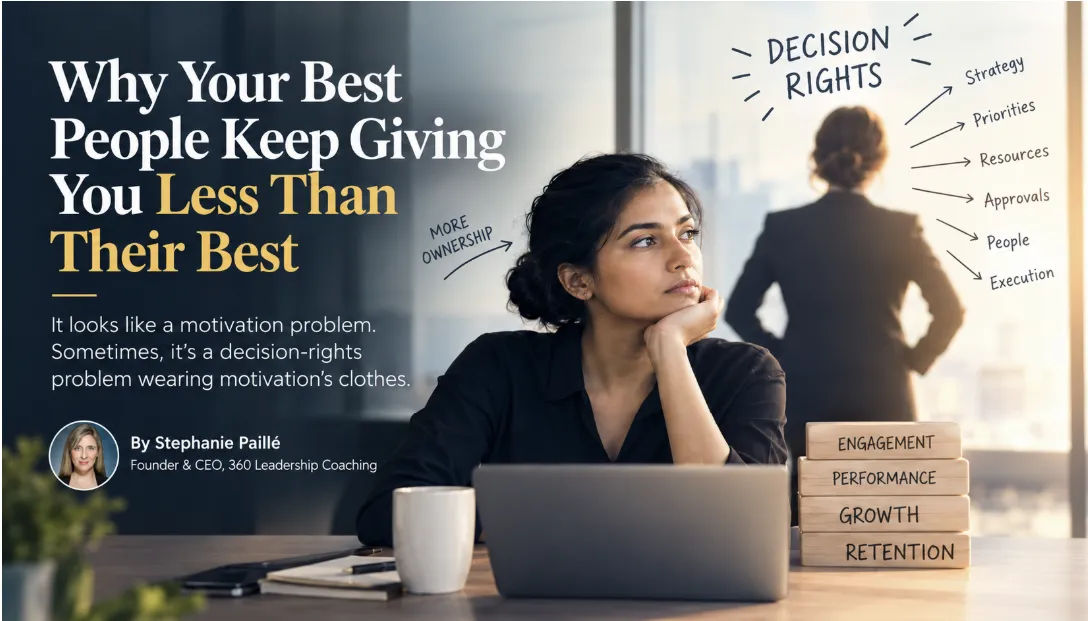
Why Your Best People Give Less Than Their Best: The Decision-Rights Gap
It looks like a motivation problem. Sometimes, it's a decision-rights problem wearing motivation's clothes.
Originally published February 2024
Employees don't always disengage because they stopped caring. Sometimes they disengage because the company keeps asking for ownership while continuing to make the decisions ownership actually requires. That gap has a name inside the Scaling CEO framework: a Decision-Rights Gap. It's rarely visible on an org chart, and it's rarely what shows up in an exit interview.
By Stephanie Paillé
Founder & CEO, 360 Leadership Coaching
Consider Isabel, the CEO of a company that has grown from two people in a spare bedroom to forty-two people across three departments.
At $2 million, Isabel set every goal herself, reviewed every deliverable, and gave feedback on almost everything her six employees produced. It worked. The company was small enough that her attention was the system.
At $8 million, she hired a management layer. She wrote clear goals, ran quarterly reviews, built a bonus structure, and started a recognition program after reading that engaged employees are more productive. Engagement scores moved a little, then flattened. Her best hire of the year left after fourteen months, and the exit interview said “looking for more ownership,” which confused her, because Isabel had told that person, more than once, that this was their project.
At $18 million, the pattern is everywhere. Managers bring her decisions instead of making them. People ask permission for things that are, on paper, entirely theirs to decide. She's not managing a company anymore; she's managing a queue.
Isabel isn't failing to motivate her people. She's still making the decisions that ownership requires, while asking her people to feel ownership anyway.
The leadership model that built the company is not the one that gets the best out of it
This is where most CEOs misdiagnose the problem. They treat underperformance and quiet disengagement as a motivation deficit, something to be closed with better goals, more feedback, sharper incentives, or a stronger culture deck. Those tools aren't wrong. They're aimed at the wrong layer.
The real question isn't “how do I get more out of my people?” It's “which decisions have I actually let them own, and which do I still quietly hold?”
The evidence: engagement is falling
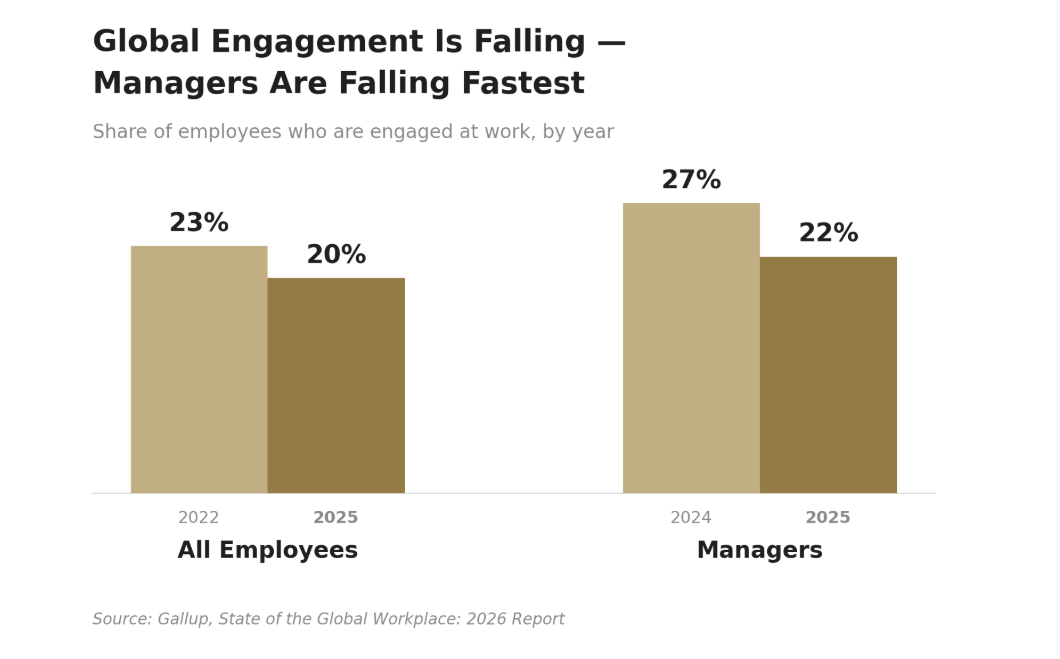
Gallup's 2026 State of the Global Workplace report, drawn from more than 263,000 respondents across more than 160 countries, found that global employee engagement fell to 20% in 2025, down from 23% in 2022 and its lowest level since the pandemic. Manager engagement, historically the strongest segment, fell even faster: from 27% in 2024 to 22% in 2025, the sharpest one-year drop Gallup has recorded. Gallup puts the economic cost of low engagement at roughly $10 trillion a year, about 9% of global GDP.
Those numbers do not prove that weak decision rights caused the decline in engagement. But they do point to an important distinction worth examining: motivation and ownership are not the same thing. A company can work hard to engage its people while still leaving them unclear about what they are actually trusted to decide.
This is a documented pattern, not a personal failing
Research on psychological ownership, the felt sense that a piece of work is genuinely “mine” points to a specific mechanism. A study by Kimbal Fraser and Simon Kemp at the University of Canterbury tested what actually produces that feeling. Formal participation and encouragement weren't enough on their own. Their research points to the importance of real control: governance control, a voice in the direction of the work; and operational control, control over how the work itself gets done. Both were associated with stronger psychological ownership and related outcomes such as organizational commitment and perceived fairness.
In other words, ownership isn't a feeling you install with culture messaging. It gets stronger when people have real control over the work they're being asked to own. When a CEO says an employee “isn't stepping up,” the more accurate sentence is often that the employee was never handed the decision to step into.
Why more feedback, more recognition, and clearer goals don't fix it
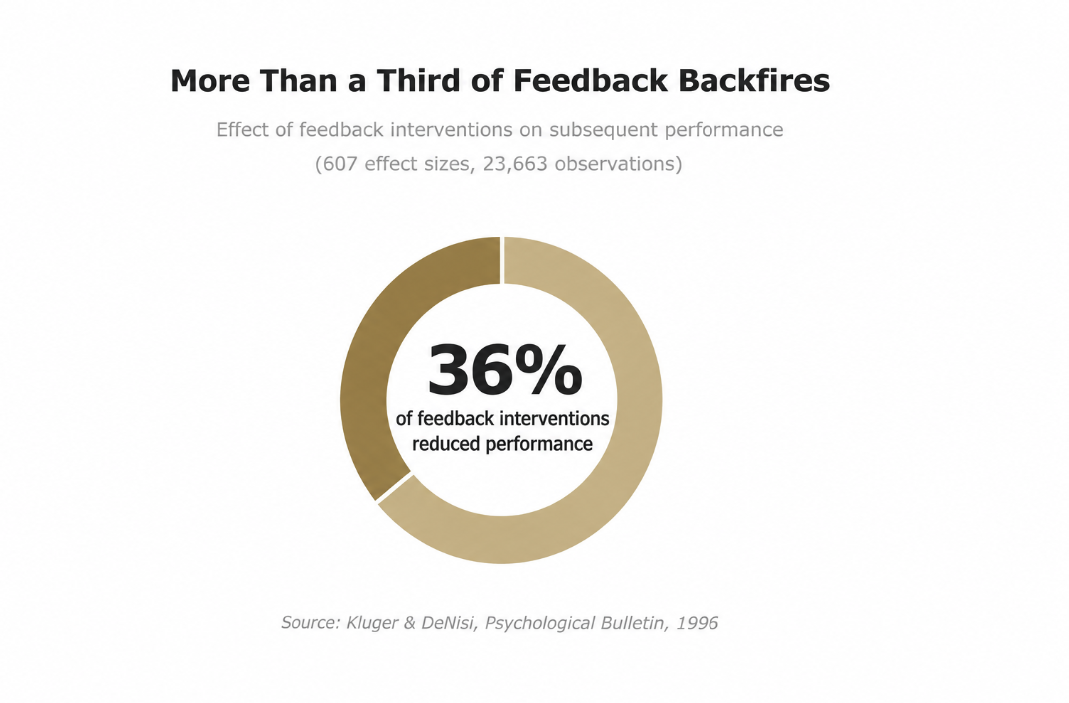
The instinct, understandably, is to add: clearer goals, more frequent feedback, better recognition, a fairer review process. Those are the standard management-advice tools, and none of them are wrong in principle. But a landmark meta-analysis by Avraham Kluger and Angelo DeNisi, covering 607 effect sizes and more than 23,000 observations, found something leadership teams rarely account for: feedback interventions improved performance on average, but made performance worse in more than a third of the cases studied. The effect had nothing to do with whether the feedback was positive or negative.
The mechanism they identified is the part that matters here. Feedback helps when it keeps a person's attention on the task. It backfires when it pulls their attention up toward themselves, toward how they're being judged, rather than toward the decision in front of them. When someone has little real authority over the outcome, feedback can stop feeling like guidance on a decision and start feeling like judgment on a result they did not fully control. There is less for them to act on, and more for them simply to absorb.
That's the trap underneath “get the best out of your employees” advice: goal-setting, feedback, and recognition are all attention-management tools. Pointed at people who lack real decision rights, they don't build ownership. They build performance theater, people who look engaged in a review and quietly wait for permission everywhere else.
Four places ownership actually gets built or quietly taken back
Getting the best out of people isn't a single fix. It's a set of decisions about where authority genuinely sits, made and re-made as the company grows.
1. Decision clarity, not just goal clarity
Most CEOs are specific about outcomes and vague about authority. Release: “I'll tell them what to hit.” Build: “I'll tell them exactly which calls are theirs to make, and which ones still route through me and why.” Ambiguity here is what quietly recreates the bottleneck goal-setting was supposed to solve.
2. Feedback aimed at the task, not the person
Per Kluger and DeNisi's mechanism, feedback that names the decision what was chosen, what the alternatives were, what to weigh differently next time builds capability. Feedback that names the person's traits or effort, however well-intentioned, pulls attention toward self-evaluation and away from the work itself.
3. Recognition that follows real authority
Rewarding outcomes people didn't actually control a metric shaped by decisions made above them doesn't build ownership. It teaches people that recognition is political, not earned, which is corrosive in exactly the opposite direction a recognition program intends.
4. Correction that doesn't quietly claw the decision back
This is the one most CEOs miss. When someone makes a bad call, the common instinct is to correct the outcome and, without saying so, start pre-approving that category of decision going forward. The correction lands. The ownership doesn't survive it. The fix isn't to avoid correcting mistakes; it's to correct the decision without repossessing the authority that came with it.
Netflix: what this looks like inside a real company
Reed Hastings' account of Netflix's culture, detailed with Erin Meyer in No Rules Rules, is a documented example of a company that built its entire operating model around this exact distinction. Netflix removed vacation policies, expense approvals, and most sign-off chains, replacing them with a principle Hastings calls “context, not control”: leaders explain the strategic landscape and the why; employees decide the how, without needing permission.
The mechanism that keeps this from collapsing into chaos isn't trust as a slogan. It's what the book calls leading with context, paired with a culture of candor: direct, specific feedback aimed at decisions and outcomes, not at personalities. When a decision goes wrong, the question inside Netflix's model isn't “why did you do that”; it's “what context did we fail to give you?” Correction that targets the information gap, not the authority itself.
The lesson isn't that every company should remove every approval. It's that Netflix treated decision rights as something to design deliberately, at the center of how it gets the best out of people, rather than as a byproduct of goal-setting and recognition programs layered on top of a structure where the real decisions never moved.
Here's the shift
The question isn't “how do I motivate my people to give me more?”
It's “which decisions have I told them are theirs, and do I actually let them make those calls?”
You don't get the best out of people by managing their motivation more skillfully. You get the best out of people by giving them real authority over real decisions, and then giving feedback that respects that authority instead of quietly undermining it. That's not a soft-skills upgrade. It's a structural one: the same decision-rights architecture that has to evolve every time the company scales.
Make the Conversation Count
Questions for your leadership teamBefore your next leadership meeting, ask:
|
|---|
Getting the best out of your people is not only a motivation question. It is also a design question about where decision rights actually sit. If this is showing up in your company, it may be worth examining where ownership is being asked for without the authority to match it.
Explore More on Scaling Leadership
This article is part of our work on the Architecture of Scaling: how decision rights, authority, accountability and leadership systems must evolve as companies grow.
Explore more insights across the Psychology, Architecture and Economics of Scaling.
Sources:
Gallup, “State of the Global Workplace: 2026 Report,” 2026
Avraham N. Kluger & Angelo DeNisi, “The Effects of Feedback Interventions on Performance: A Historical Review, a Meta-Analysis, and a Preliminary Feedback Intervention Theory,” Psychological Bulletin, 1996
Kimbal Fraser & Simon Kemp, “Effects of Employee Governance and Operational Control on Psychological Ownership and Perceived Justice,” University of Canterbury
Reed Hastings & Erin Meyer, No Rules Rules: Netflix and the Culture of Reinvention (Penguin Press, 2020) — overview via INSEAD Faculty & Research